Key Takeaways
- Core system replacement is the highest-risk, highest-reward technology decision an insurer makes — and most insurers delay it for too long.
- The biggest fear — business disruption during migration — is manageable with the right platform architecture and migration methodology.
- CLAPi©'s 8-module structure allows insurers to migrate progressively, module by module, rather than in a single high-risk cutover.
- DevOps-grade deployment infrastructure (Jenkins CI/CD, Docker, Kubernetes) provides the technical foundation for zero-downtime transitions.
- Insurers across Singapore, Hong Kong, and India have completed CLAPi© migrations and gone live with new business in weeks.
Of all the technology decisions an insurance company makes, replacing the core policy administration system is the one that generates the most anxiety in the boardroom. The concerns are legitimate: a botched migration can disrupt policy issuance, claims processing, and premium collection simultaneously — affecting every policyholder, every distribution partner, and every operational team.
Yet the cost of not replacing a legacy core system is also significant and compounding. Every year an insurer operates on outdated infrastructure is a year in which new product launches are slower, distribution integrations are more expensive, and operational costs are higher than they need to be.
This guide is for insurance CTOs, COOs, and transformation leads who are weighing a core system replacement in 2026. It addresses the most common concerns directly and outlines a migration approach that manages risk without sacrificing momentum.
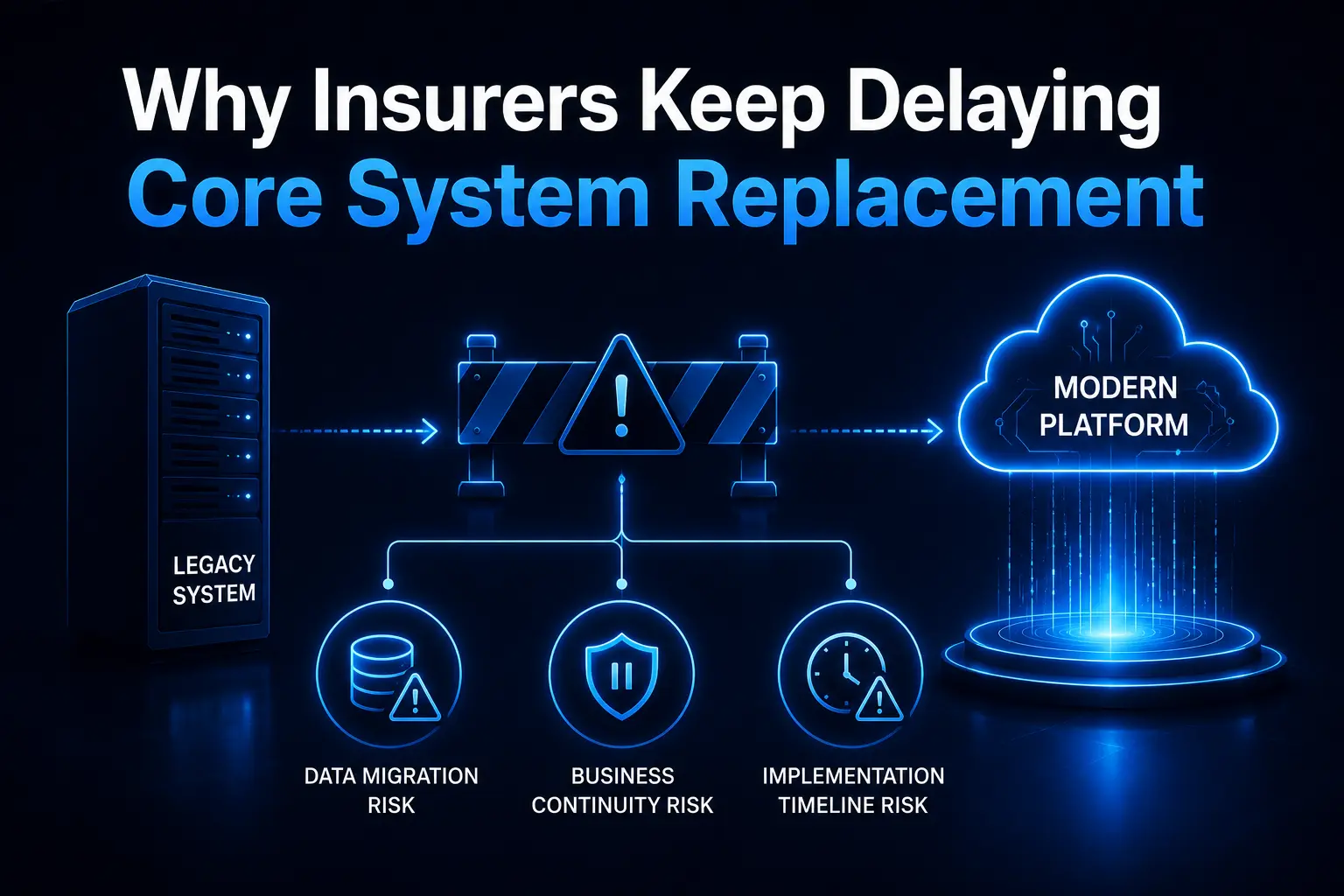
Why Insurers Keep Delaying Core System Replacement
The pattern is familiar across the industry. An insurer’s technology leadership recognises that the current core system is limiting the business. A business case is built. A vendor evaluation begins. And then the project stalls — sometimes for years — because the risk of migration feels greater than the cost of staying put.
Three fears drive most of these delays:
- Data migration risk: “We have twenty years of policy data in the current system. What if it is corrupted or lost during migration?"
- Business continuity risk: “We cannot afford any downtime in policy issuance or claims processing. A disruption would affect policyholders and trigger regulatory scrutiny."
- Implementation timeline risk: “We have heard stories of core system replacements that took three years and cost twice the original budget."
All three fears are grounded in real experiences with legacy migration approaches. But they are not inherent to core system replacement itself — they are characteristics of specific migration methodologies and platform architectures that are avoidable with the right approach.
The Migration Approach: Why It Changes the Risk Profile
The most significant risk reduction in modern core system replacement comes from the shift from monolithic cutover migration to modular progressive migration. The difference is fundamental.
| Monolithic cutover migration | Modular progressive migration (CLAPi©) |
|---|---|
| Single high-risk go-live event affects entire operation | Each module transition is a contained, lower-risk event |
| Full data migration must complete before go-live | Data migration is staged per module, validated incrementally |
| Any delay pushes the entire programme | Individual module delays do not affect other module timelines |
| Rollback of failed go-live is catastrophic | Rollback of a single module is contained and manageable |
CLAPi©’s Module architecture — Product Workspace, Rule Engine, Entity Management, Policy Administration, Policy Accounting, Claims Management / TPA, Provider Management, and Reinsurance — is specifically designed to support this migration approach. Each module can be deployed and validated independently, with the existing legacy system remaining operational for modules not yet transitioned.
The CLAPi© Modules Framework
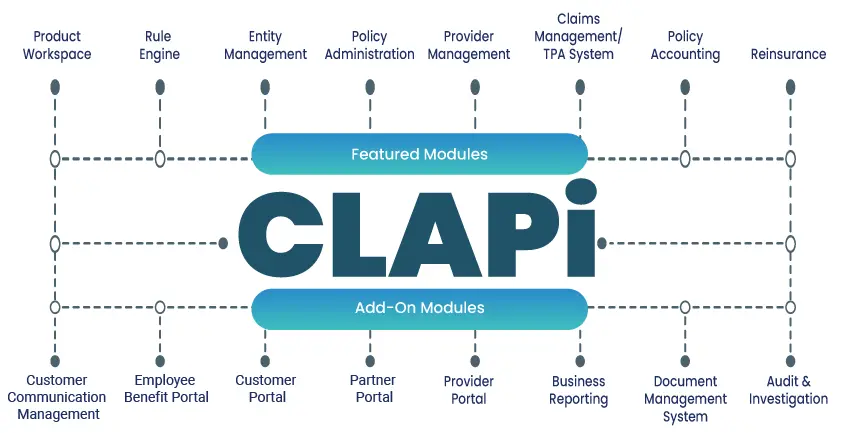
A typical CLAPi© migration follows a structured sequence that builds operational confidence progressively:
-
Product Workspace + Rule Engine
These two foundational modules define how insurance products are structured and how business rules operate. Starting here allows the insurer’s product team to validate that all existing product configurations can be replicated in CLAPi© before any live policies are touched. CLAPi©’s Excellator tool — which allows product configuration at 10x speed using Excel with no coding — dramatically accelerates this phase for insurers with large product catalogues
-
Entity Management + Policy Administration
With product configurations validated, Entity Management (managing groups, employers, members, and relationships) and Policy Administration (the full policy lifecycle from issuance to renewal) can be migrated. New business from this point runs on CLAPi©, while in-force policies on the legacy system continue to be serviced there until they naturally renew.
-
Policy Accounting + Claims Management / TPA
Premium accounting and claims processing migrate together in Phase 3. CLAPi©’s Claims Management module includes integrated TPA system capability, meaning third-party administrator workflows are handled natively rather than requiring a separate integration. The Audit & Investigation add-on module provides full claims audit trails from day one.
-
Provider Management + Reinsurance
Provider network management and reinsurance complete the core migration. With Reinsurance as Module 08 in CLAPi©’s native core — not a bolt-on — cession schedules, treaty management, and bordereaux generation integrate automatically with the policy and claims data already live on the platform.
The Technology Infrastructure That Makes Zero-Downtime Migration Possible
Beyond the migration methodology, the technical infrastructure of the target platform determines whether zero-downtime migration is achievable. CLAPi© is built on enterprise-grade DevOps infrastructure that makes this possible:
- Jenkins CI/CD pipeline: Automated build, test, and deployment pipeline ensures that every code change is validated before reaching the production environment, eliminating manual deployment errors.
- Docker containerisation: Each CLAPi© module is containerised, meaning it can be deployed, updated, and rolled back independently without affecting other modules.
- Kubernetes orchestration: Container orchestration across Node A and Node B deployment environments provides automatic failover, load balancing, and zero-downtime rolling updates.
- AWS CodeCommit + GitHub version control: All configuration and code changes are tracked with full version history, enabling precise rollback to any prior state if needed.
- SonarQube code quality control: Automated code quality gates prevent defects from reaching production, reducing the risk of post-migration system issues.
This infrastructure stack means that CLAPi© deployments can be updated, patched, and scaled without scheduled maintenance windows — a fundamental contrast with legacy systems that require downtime for every update.
Data Migration: The Concern Every Insurer Has
Data migration is the most frequently cited concern in core system replacement programmes, and it is a legitimate one. An insurer’s policy data represents years or decades of business relationships, and any corruption or loss during migration has direct consequences for policyholders and regulatory compliance.
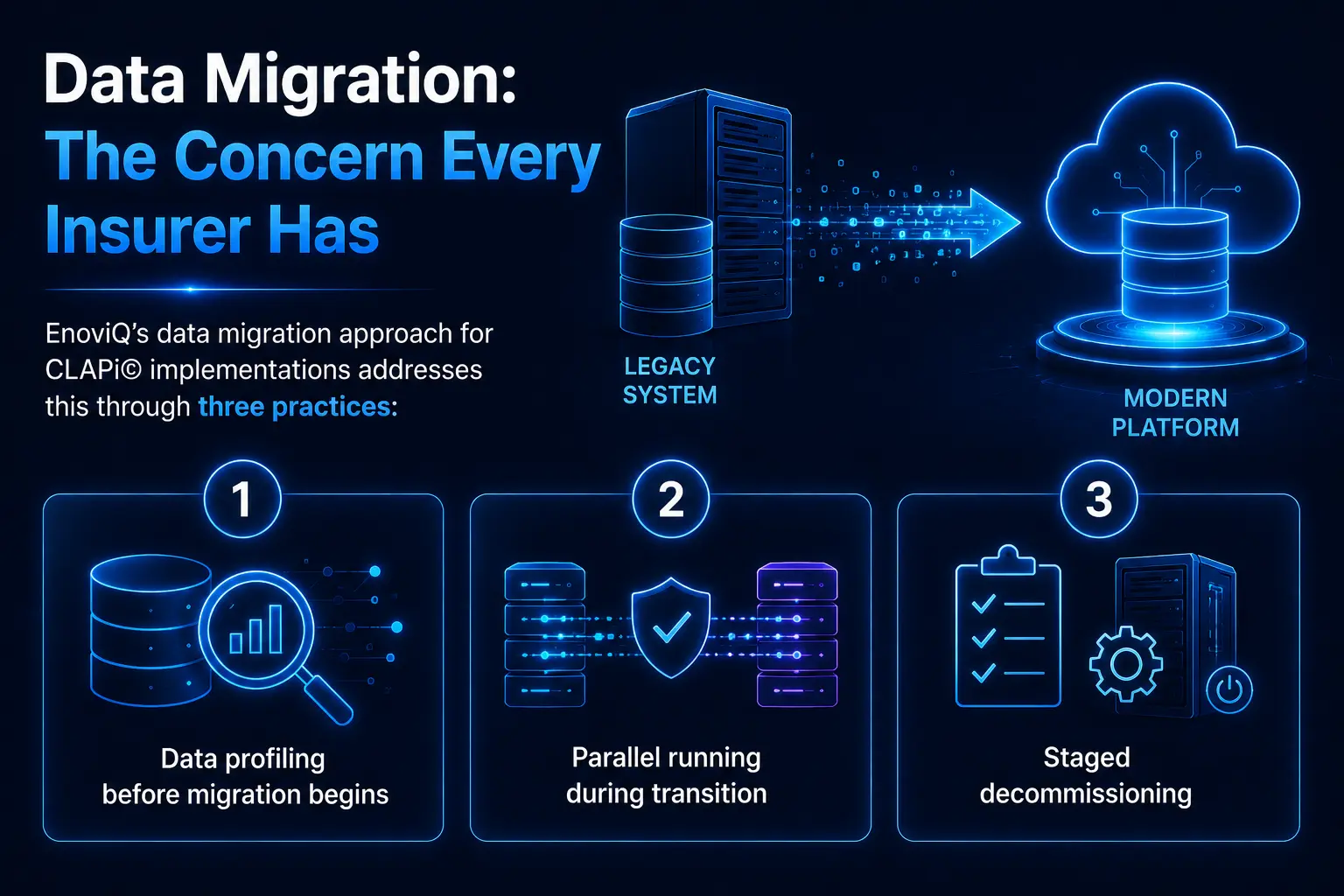
EnoviQ’s data migration approach for CLAPi© implementations addresses this through three practices:
-
Data profiling before migration begins
Before any data is moved, EnoviQ’s Business & System Analysis service (one of CLAPi©’s five Professional Services) conducts a full inventory of the insurer’s existing data: schema mapping, data quality assessment, and identification of legacy data anomalies that need remediation before migration. This eliminates surprises during the migration itself.
-
Parallel running during transition
During the modular migration phases, CLAPi© and the legacy system run in parallel for the modules being transitioned. Policy data is validated in CLAPi© against the legacy record before the legacy system is decommissioned for that module. Any discrepancy is identified and resolved before the cut.
-
Staged decommissioning
Legacy system modules are decommissioned only after the corresponding CLAPi© module has been validated in production for a defined period. This staged approach means the insurer never loses access to historical data before the new system has been confirmed to hold it correctly.

What “Live in Weeks" Actually Means in a Migration Context
EnoviQ’s “live in weeks, not months" implementation claim is frequently questioned by insurers who have experienced multi-year core system replacements. The clarification is important: for new product lines or greenfield deployments on CLAPi©, first policy issuance can be achieved in weeks using pre-built product frameworks and standard module configurations.
For full legacy system migrations, the timeline is longer — but the modular approach means the insurer begins generating business value in weeks rather than waiting until the entire migration is complete. Phase 1 (Product Workspace + Rule Engine) completion allows the product team to begin configuring new products on CLAPi© immediately, even while Phases 2 through 4 are still in progress.
The Feasibility Study / Sandboxing professional service allows insurers to validate their specific migration requirements in a CLAPi© sandbox environment before committing to the full programme — providing concrete evidence of migration complexity and timeline before the project begins.
Regulatory Compliance During Migration
APAC regulatory frameworks — IRDAI in India, MAS in Singapore, IA and SFC in Hong Kong — impose specific requirements on insurers’ technology systems, including requirements related to data integrity, audit trails, and system availability. A core system migration that compromises compliance with these requirements creates regulatory risk that can be more costly than the migration itself.
CLAPi©’s built-in Audit & Investigation add-on module maintains complete audit trails of all system activity throughout the migration period. The parallel running approach ensures that regulatory reporting can continue uninterrupted from the legacy system while CLAPi© is being validated. EnoviQ’s Platform Consulting service includes regulatory compliance review as part of the migration planning process.
FAQs
The timeline depends on the insurer’s product complexity, data volume, and the number of lines of business being migrated. For standard implementations, Phase 1 (Product Workspace + Rule Engine) can be completed in four to eight weeks. Full migration across all eight modules typically takes six to eighteen months, depending on complexity — significantly less than legacy replacement programmes that often run two to three years.
CLAPi©’s modular migration approach allows in-force policies to remain on the legacy system until their natural renewal date, at which point they transition to CLAPi©. This eliminates the need to forcibly migrate active policies and significantly reduces migration risk and complexity.
EnoviQ’s migration methodology includes data profiling before migration, parallel running during transition (with CLAPi© data validated against the legacy record), and staged decommissioning only after CLAPi© data integrity has been confirmed in production. The Audit & Investigation module provides complete audit trails throughout.
Excellator is CLAPi©’s no-code, Excel-to-API product configuration tool that allows insurance product teams to configure products at 10x speed without writing code. During migration, Excellator dramatically accelerates the Phase 1 product re-configuration exercise — reducing the time needed to rebuild the insurer’s product catalogue in CLAPi© from weeks to days.
EnoviQ provides five professional services for CLAPi© migrations: Platform Consulting (migration strategy and planning), API Monetisation Assessment (evaluating API integration opportunities), Technical Platform Assessment (detailed technical architecture review), Business & System Analysis (data profiling and requirements mapping), and Feasibility Study / Sandboxing (validating migration requirements in a CLAPi© test environment before commitment).
Plan Your Core System Migration with EnoviQ
If you are evaluating a legacy insurance core system replacement or planning a core system modernisation programme, EnoviQ’s team can help you assess your specific migration requirements and build a realistic transition plan. Our Feasibility Study / Sandboxing service allows you to validate CLAPi© against your existing system before committing to the full programme.