Key Takeaways
- Micro insurance is a high-volume, low-margin business — the technology platform determines whether it is operationally viable.
- Most legacy insurance systems are built for low-volume, high-premium products and break down at micro insurance scale.
- A micro insurance technology platform must handle automated issuance, instant claims, low-cost administration, and high-volume distribution through embedded channels.
- Embedded insurance is the most effective distribution model for micro insurance — requiring deep API integration with digital partners.
- CLAPi© GroupCore’s micro insurance module is built for high-volume, low-premium administration with embedded distribution capability built in.
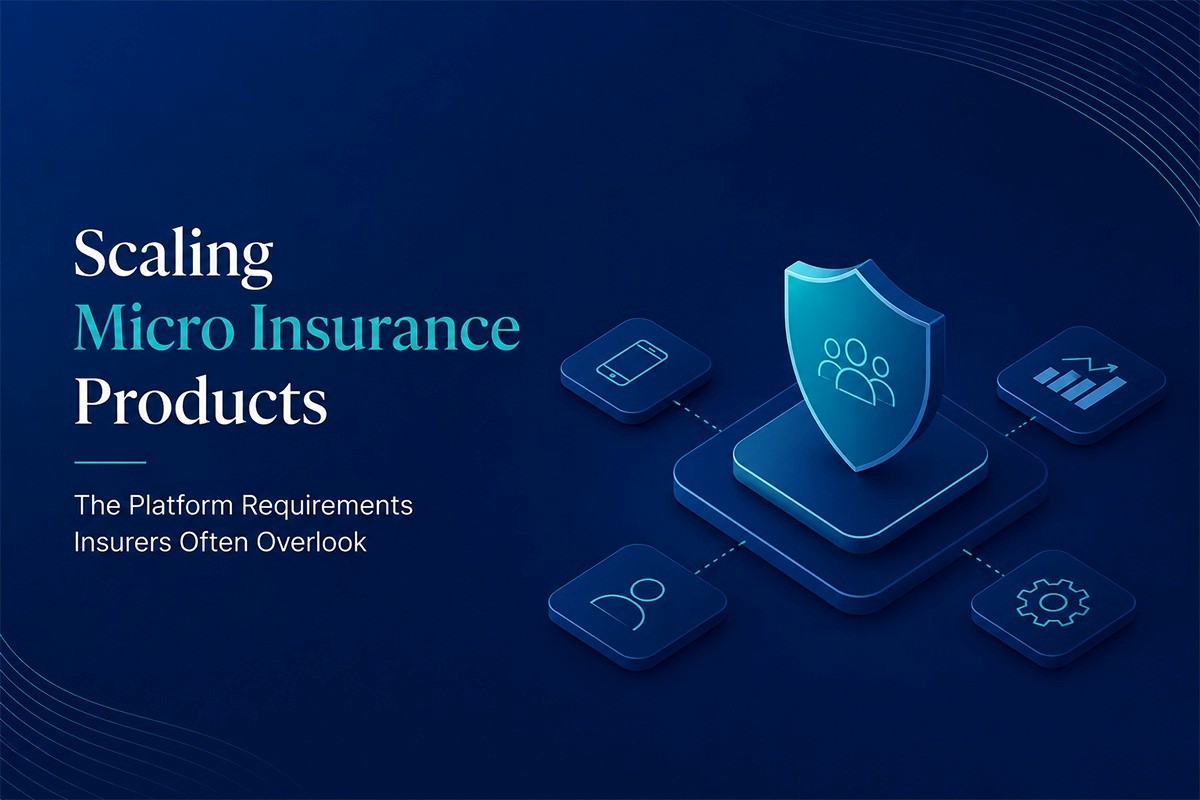
Micro insurance is one of the most commercially compelling opportunities in insurance today. Across Asia Pacific, Africa, and emerging markets more broadly, billions of working adults remain underinsured or entirely uninsured — not because they do not want coverage, but because conventional insurance products are priced, distributed, and administered in ways that make them inaccessible.
For insurers, this represents a genuine market expansion opportunity. The question is not whether micro insurance is commercially viable — it is. The question is whether the insurer’s technology platform is capable of administering it profitably.
This is the requirement that most insurers overlook when they enter the micro insurance space. They apply conventional system thinking to an unconventional product model, and the operational costs undermine the economics. This guide outlines the specific platform requirements that make micro insurance scalable — and what insurers must demand from their micro insurance software before they commit to a product launch.
Why Micro Insurance Breaks Conventional Insurance Platforms
Traditional insurance administration systems are engineered for a specific operational profile: a relatively small number of policies, each with significant premium value, managed by teams of underwriters, policy administrators, and claims officers. The economics of that model support manual touchpoints at every stage of the policy lifecycle.
Micro insurance inverts this model entirely. Policy counts run into the hundreds of thousands or millions for a viable book of business. The administration cost per policy must be a fraction of a cent to preserve any margin at all.
When insurers attempt to run micro insurance on conventional systems, the results are predictable:
- Manual policy issuance processes that cost more per policy than the annual premium collected.
- Claims handling workflows designed for large individual claims that are completely disproportionate to a $5 hospital cash benefit.
- Reinsurance and accounting processes that generate administrative overhead at the transaction level, not the portfolio level.
- Distribution models limited to traditional broker and direct channels, which cannot reach the uninsured populations that micro insurance is designed to serve.
The solution is not to simplify the insurance product — it is to build or select a micro insurance technology platform designed from the ground up for high-volume, low-premium, automated administration.
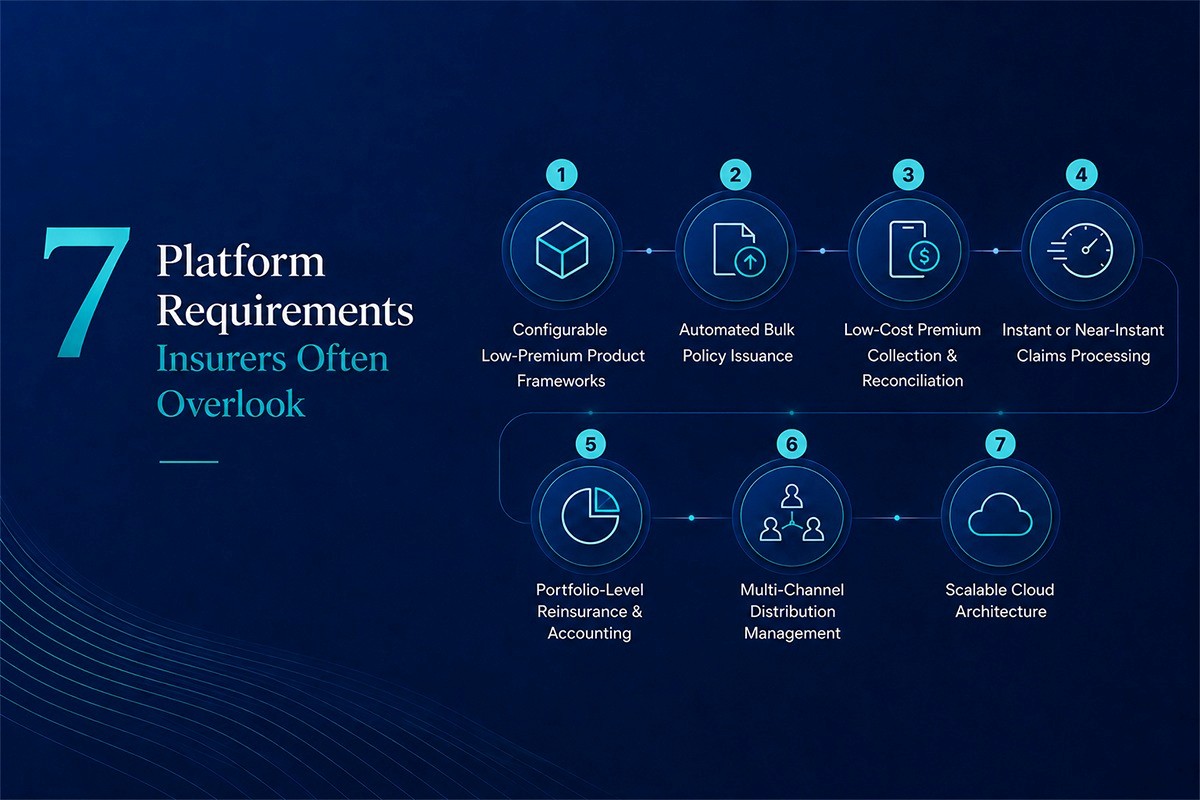
The 7 Platform Requirements Insurers Often Overlook
Based on EnoviQ’s experience deploying micro insurance programmes across Asia Pacific and Africa, the following seven platform requirements are the ones insurers most commonly underestimate or overlook during vendor evaluation:
-
Configurable Low-Premium Product Frameworks
Micro insurance products come in many forms: hospital cash, life cover, personal accident, crop protection, and funeral insurance are among the most common. Each has a distinct benefit structure, claims trigger, and documentation requirement. The platform must support rapid product configuration — not custom development — for each product type, allowing insurers to launch new micro products in weeks rather than months.
-
Automated Bulk Policy Issuance
A micro insurance programme enrolling members through a bank, mobile network operator, or fintech partner may onboard thousands of new policyholders per day. The platform must handle bulk enrolment files — typically via API or batch upload — and issue policy records automatically without manual review for standard enrolments. Any system that requires human intervention per policy issuance is not viable at micro scale.
-
Low-Cost Premium Collection and Reconciliation
Micro insurance premiums are often collected through non-traditional payment channels — mobile money, airtime deduction, salary deduction, or bundled with a product subscription. The platform must integrate with these payment mechanisms through pre-built connectors and reconcile collections automatically against the policy ledger. Manual premium reconciliation at transaction level is cost-prohibitive.
-
Instant or Near-Instant Claims Processing
For a low-income policyholder, a 30-day claims settlement cycle is not insurance — it is an administrative process with uncertain outcomes. Micro insurance claims must be processed and settled within 24 to 72 hours to be meaningful. This requires automated claims adjudication for standard benefit types (hospital admission confirmation, death certificate validation, parametric weather data) with exception routing for anomalous claims only.
-
Portfolio-Level Reinsurance and Accounting
At micro insurance scale, transaction-level reinsurance cession is operationally impossible. The platform must support aggregate or portfolio-level reinsurance treatment, where cession is calculated and reported at the portfolio level rather than per individual policy. Similarly, premium accounting and loss reserve calculations must operate at the cohort or scheme level, not the individual policy level.
-
Multi-Channel Distribution Management
Micro insurance distribution is fundamentally different from conventional insurance distribution. The most effective channels — mobile network operators, fintechs, microfinance institutions, agricultural cooperatives, and digital platforms — each require a different integration model. The platform must support multi-channel partner management, with partner-specific enrolment rules, commission structures, and reporting — accessible through a shared API layer rather than separate integrations per channel.
-
Scalable Cloud Architecture
A micro insurance programme that succeeds will grow rapidly. An insurer that launches with 50,000 members and scales to 2 million within eighteen months needs a platform that scales with the business — without re-platforming, additional infrastructure procurement, or performance degradation. Cloud-native, multi-tenant architecture is the only infrastructure model that supports this growth curve without prohibitive cost.
Embedded Insurance: The Distribution Model That Makes Micro Insurance Viable
Of all the platform requirements for micro insurance, the most strategically significant — and most commonly underinvested — is embedded insurance distribution capability. Embedded insurance refers to insurance coverage that is integrated directly into a non-insurance product or service at the point of purchase or consumption, rather than sold as a standalone product through a separate insurance channel.
For micro insurance, embedded distribution is not a nice-to-have feature. It is the primary mechanism through which low-premium products reach the populations they are designed to serve at the scale needed to make them economically viable.
How Embedded Insurance Works for Micro Products
Consider the following embedded micro insurance models, each of which requires deep platform integration capability:
- Mobile network operator (MNO) bundling: A mobile operator includes micro life or accident cover as a loyalty benefit for prepaid subscribers who maintain a minimum airtime spend. The insurer’s platform receives daily membership data from the MNO, automatically issues or lapses cover based on eligibility rules, and processes claims triggered by policyholder notification via USSD or mobile app.
- Microfinance institution (MFI) credit life: A microfinance lender automatically covers all active borrowers under a group credit life scheme. The insurer’s platform receives loan disbursement and repayment data from the MFI’s loan management system, dynamically adjusts sum assured as loan balances change, and settles claims directly against the outstanding loan balance upon notification of borrower death.
- E-commerce and digital platform bundling: An e-commerce platform or ride-hailing app offers optional micro personal accident cover at checkout or ride initiation. The insurer’s platform issues a policy via API in real time at the point of purchase, with coverage active for the duration of the transaction or journey and claims submitted through the same digital interface.
- Agricultural input supplier bundling: A seed or fertiliser supplier bundles parametric crop insurance with product purchases. Coverage triggers automatically based on verified weather data — rainfall deficit, excess temperature — without requiring the farmer to file a claim. The insurer’s platform monitors weather indices and initiates automatic settlements when trigger conditions are met.
Each of these models requires a platform capability that goes beyond conventional insurance administration: real-time API integration with non-insurance partner systems, automated eligibility management, and in some cases fully automated claims settlement without manual policyholder interaction.
This is where embedded insurance and micro insurance technology requirements converge. A low-premium insurance platform that cannot integrate with digital distribution partners through open APIs is limited to traditional channels — and traditional channels cannot reach micro insurance markets at the required scale or cost point.
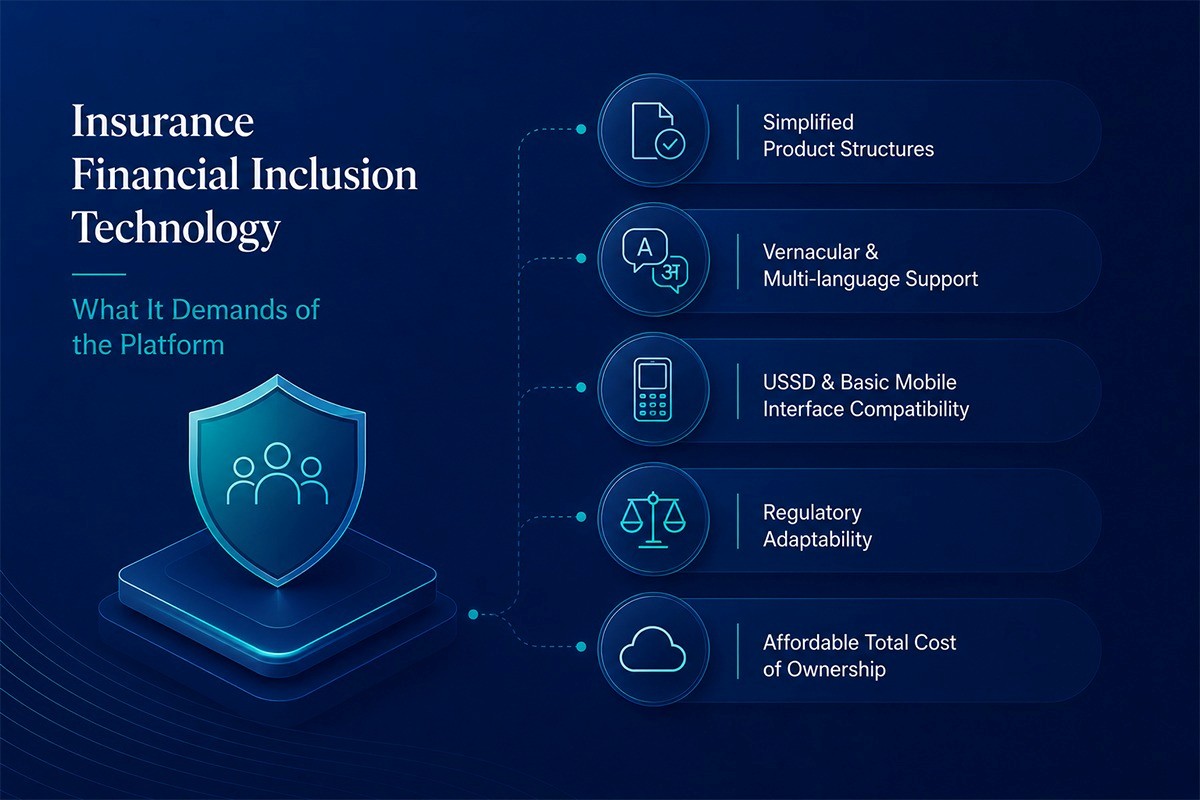
Insurance Financial Inclusion Technology: What It Demands of the Platform
Insurance financial inclusion technology — the systems and platforms that extend insurance access to underserved populations — places a specific set of demands on the underlying platform that differ from both conventional group insurance and from retail insurance administration:
- Simplified product structures: Micro insurance products must be simple enough to be understood, purchased, and claimed without specialist knowledge. The platform must support the administration of genuinely simple products — fixed-benefit, limited exclusions, clear triggers — without requiring the complexity overhead of conventional insurance product frameworks.
- Vernacular and multi-language support: Distribution across diverse markets in Asia Pacific, Africa, and South Asia requires the platform to support policy documents, SMS notifications, and claims communications in multiple languages and scripts.
- USSD and basic mobile interface compatibility: In markets where smartphone penetration is low, policyholders interact with insurance products through basic mobile interfaces — USSD menus, SMS, or feature phone apps. The platform’s API must support these interaction models, not just web and smartphone channels.
- Regulatory adaptability: Micro insurance regulation varies significantly across APAC markets — India’s IRDAI has specific micro insurance product and distribution regulations, while African markets have their own frameworks. The platform must be configurable to each regulatory environment without custom development per market.
- Affordable total cost of ownership: The economics of micro insurance only work if the platform’s cost per policy administered is exceptionally low. SaaS-based, cloud-native deployment with consumption-based pricing is the only model that aligns platform cost with micro insurance economics.
How CLAPi© GroupCore Supports Scalable Micro Insurance Administration
CLAPi© GroupCore includes a dedicated Micro Insurance module built for the specific operational requirements of high-volume, low-premium insurance programmes. Unlike add-on modules bolted onto a conventional group insurance platform, GroupCore’s micro insurance capability is built on the same cloud-native, multi-tenant, API-first architecture as the rest of the platform.
Key micro insurance capabilities within GroupCore include:
- Bulk enrolment processing via API or batch file, supporting MNO, MFI, cooperative, and digital platform partner models.
- Automated policy issuance and lapse management based on eligibility rules configured per scheme, without manual intervention.
- Pre-built product frameworks for the most common micro insurance product types — micro life, micro accident, hospital cash, and credit life — configurable to partner and market specifications.
- Automated claims adjudication for standard benefit triggers, with exception routing for complex or anomalous claims.
- Portfolio-level reinsurance and accounting treatment, designed for the aggregate reporting requirements of micro insurance books.
- Embedded insurance API layer for real-time integration with digital distribution partners, including pre-built connectors for common payment and partner data formats.
GroupCore’s scalable insurance platform architecture — built on cloud infrastructure with multi-tenant deployment — means that micro insurance programmes launched on the platform can scale from thousands to millions of members without infrastructure changes or re-platforming costs.
EnoviQ has deployed GroupCore’s micro insurance capability across markets in Asia Pacific and Africa, supporting insurers operating MNO bundling, MFI credit life, and digital platform embedded insurance programmes.
FAQs
A micro insurance technology platform is an insurance administration system specifically designed for high-volume, low-premium insurance products. Unlike conventional insurance platforms built for low-volume, high-value policies, a micro insurance platform automates policy issuance, premium collection, and claims processing at scale — keeping the administration cost per policy low enough to preserve margin on sub-dollar premiums.
Conventional group insurance typically involves employer-sponsored schemes for formal sector employees, with premium levels that support individual underwriting and manual administration. Micro insurance targets lower-income and informal sector populations with very low premium products — often below $1 per month — distributed through non-traditional channels such as mobile networks, microfinance institutions, and digital platforms. The technology requirements differ significantly, particularly in volume, distribution integration, and claims automation.
Embedded insurance integrates coverage directly into a non-insurance product or transaction at the point of purchase. For micro insurance, this might mean life cover bundled with a mobile airtime subscription, accident cover triggered at the start of a ride-hailing journey, or crop insurance activated when a farmer purchases seeds. The insurer’s platform issues, manages, and settles the policy automatically via API integration with the distribution partner, without requiring the customer to interact with a separate insurance purchase process.
Asia Pacific represents the largest underinsured population in the world. Markets including India, Indonesia, Philippines, Vietnam, and sub-Saharan Africa have hundreds of millions of working adults with no access to formal insurance. Regulators including India’s IRDAI and several African insurance regulators have introduced specific micro insurance frameworks to encourage product development. The combination of regulatory support, mobile penetration, and digital payment infrastructure makes APAC the primary growth market for micro insurance over the next decade.
EnoviQ’s pre-built micro insurance product frameworks — covering micro life, accident, hospital cash, and credit life — allow insurers to configure and launch a new micro insurance product in weeks rather than months. The timeline depends on the complexity of the distribution partner integration and the degree of product customisation required, but standard micro insurance product launches on GroupCore typically achieve first policy issuance within four to eight weeks of project initiation.
Ready to Scale Your Micro Insurance Programme?
Whether you are launching a new micro insurance product, expanding an existing programme to new distribution channels, or evaluating whether your current platform can support the operational requirements of micro insurance at scale, EnoviQ’s team can help.
CLAPi© GroupCore’s micro insurance module is built for exactly the challenges this article describes — high volume, low premium, embedded distribution, automated administration. Our team can walk you through a live demonstration tailored to your specific product and market requirements.