Key Takeaways
- CLAPi© stands for Cloud-based API Platform for Insurance — API-first architecture is not a feature of EnoviQ’s platform, it is the platform.
- The difference between API-first and monolithic architecture determines how fast an insurer can add distribution partners, launch products, and integrate with external systems.
- Monolithic platforms add API capability as an afterthought — resulting in limited, inconsistent, and expensive integration.
- An API-first platform exposes every core function — quoting, issuance, claims, reporting — as a documented, callable API from the ground up.
- CLAPi© has hundreds of pre-built APIs across all insurance functions, built on microservices, containers, serverless functions, and immutable infrastructure.
The term “API-first” has become common in insurance technology marketing. Vendors that were built decades before APIs existed now describe themselves as API-enabled, API-ready, or API-first — distinctions that are meaningful to a technology architect but easy to confuse in a vendor evaluation.
This article cuts through the marketing language and explains what API-first architecture actually means in an insurance platform context — how it differs from monolithic platforms with API wrappers, what the practical business consequences of the difference are, and why the architecture choice you make in a platform selection determines your ability to grow through digital distribution channels for years to come.
What API-First Actually Means
An API-first platform is one that was designed from the beginning with the API as the primary interface — not as an addition to an existing system. In practical terms, this means that every function the platform performs — creating a quote, issuing a policy, processing a claim, generating a document, calculating a premium — is built as a discrete, callable API service before any user interface is built on top of it.
CLAPi© — Cloud-based API Platform for Insurance — is named for this design principle. The platform contains hundreds of pre-built APIs covering the full insurance value chain: new business, underwriting, policy administration, claims, reinsurance, provider management, and reporting. These APIs are not wrappers around legacy functions — they are the functions themselves, accessible directly by any system that needs them.
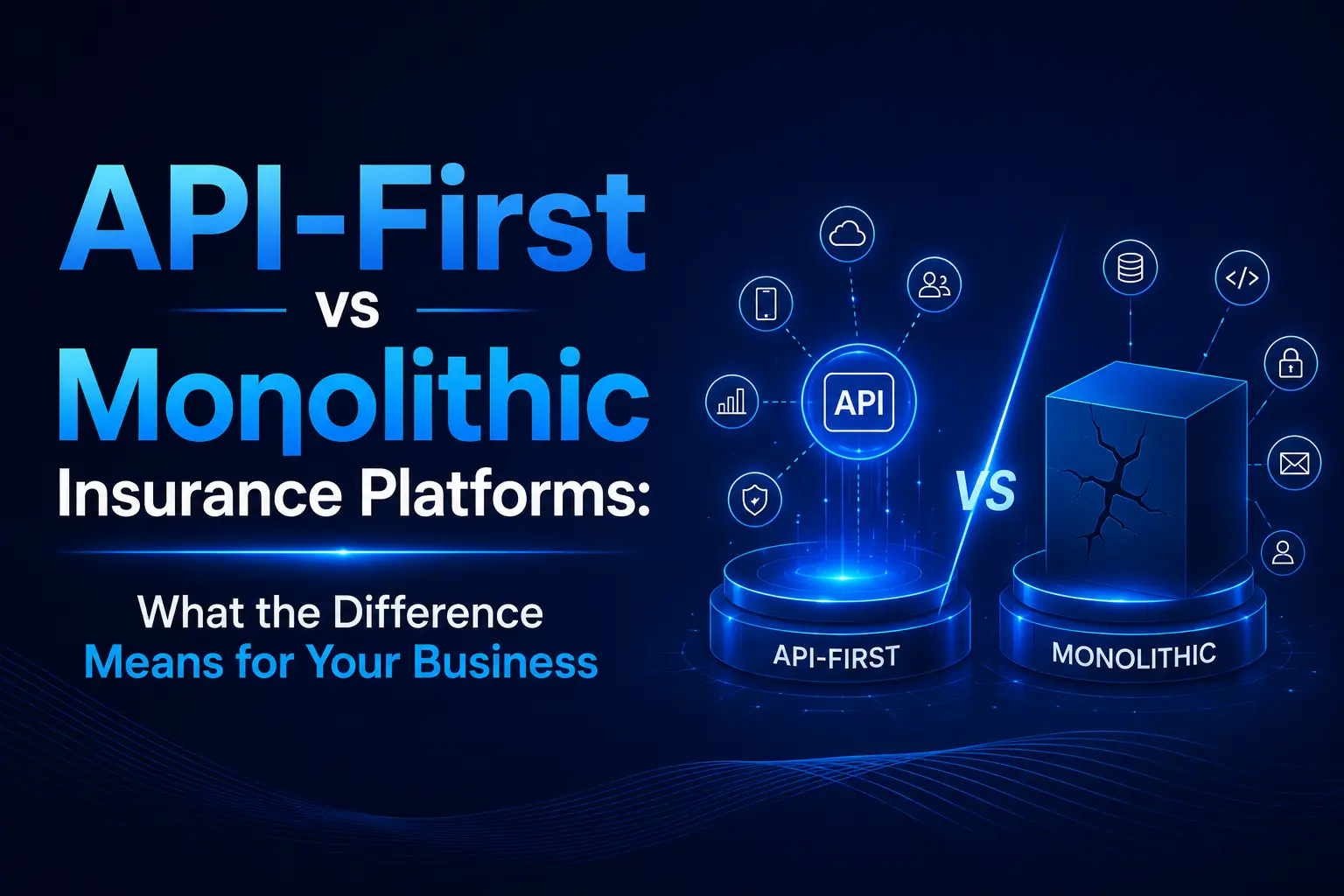
A monolithic platform, by contrast, was built as a single, integrated application where all functions are tightly coupled. Adding APIs to a monolithic platform — as most legacy vendors have done — means wrapping existing functions in API endpoints after the fact. The underlying architecture remains monolithic, and the API layer inherits all of the constraints that come with it.
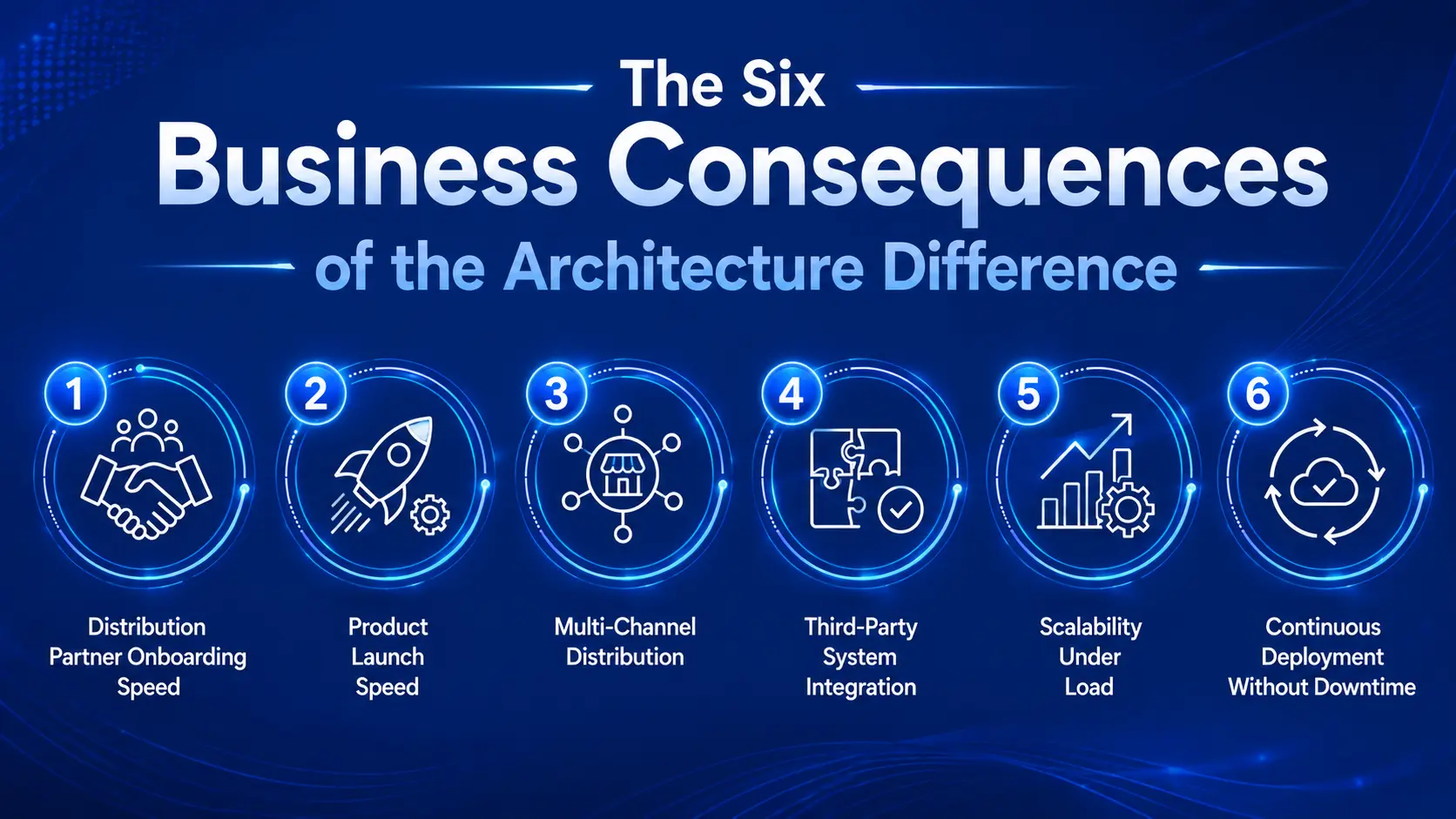
The Six Business Consequences of the Architecture Difference
-
Distribution partner onboarding speed
On a monolithic platform with API wrappers, onboarding a new distribution partner — a bank, fintech, or affinity programme — typically requires a custom integration project. The API wrapper exposes limited functionality, data formats are inconsistent, and the partner’s technical team must work around the monolith’s constraints. On CLAPi©, distribution partners connect to a standardised, fully documented API layer that exposes all platform functions. A new bancassurance partner or affinity channel can integrate and go live in days to weeks rather than months.
-
Product launch speed
CLAPi©’s Excellator add-on — an Excel-to-API no-code product configuration tool — allows insurance product teams to configure and launch new products at 10x speed without writing code. This is possible specifically because the Rule Engine and Product Workspace modules are built as API services:. On a monolithic platform, product configuration changes typically require IT involvement and testing cycles.
-
Multi-channel distribution
CLAPi© currently supports seven lines of business — Group Insurance, Retail Insurance, Micro Insurance, Travel Insurance, Personal Accident Insurance, Banca Insurance, and Embedded Insurance — all distributed through the same API layer. A bancassurance partner, a digital affinity platform, and an embedded insurance integration all connect to the same APIs, with channel-specific configuration applied at the platform level. On a monolithic platform, adding a new distribution channel often requires a separate integration build for each channel.
-
Third-party system integration
CLAPi©’s API-first architecture allows seamless integration with external systems: Payment gateways for premium collection, mobile money platforms for micro insurance, document management systems, CRM platforms, and regulatory reporting systems. Because every CLAPi© function is an API, any external system that can call an API can integrate with it. On monolithic platforms, each of these integrations typically requires custom middleware development.
-
Scalability under load
CLAPi© is built on microservices architecture, with each platform function running as an independent service in Docker containers, orchestrated by Kubernetes across redundant deployment environments. When transaction volumes spike — during a bancassurance product launch, a group renewal period, or a micro insurance campaign — Kubernetes automatically scales the specific services under load without scaling the entire system. Monolithic platforms scale as a whole, meaning every component must be scaled even if only one function is under pressure.
-
Continuous deployment without downtime
CLAPi©’s Jenkins CI/CD pipeline, combined with Docker containerisation and Kubernetes rolling updates, allows the platform to be updated, patched, and enhanced without scheduled downtime. Individual microservices can be updated independently — the Claims Management service can be updated without touching the Policy Administration service. Monolithic platforms require the entire system to be taken offline for updates, resulting in maintenance windows that affect all users and all functions simultaneously.
Monolithic with API Wrappers: How to Identify It in a Vendor Evaluation
The challenge in a platform evaluation is that monolithic vendors have learned to use API-first language. These questions will quickly reveal whether a vendor’s API capability is genuine or cosmetic:
- How many APIs does your platform expose, and what functions do they cover? A genuine API-first platform has hundreds of APIs covering every platform function. A monolithic platform with wrappers will have a limited set covering only the most common integration points.
- Can you show us the API documentation? Genuine API-first platforms have complete, versioned API documentation that is publicly accessible. Wrapper APIs are often undocumented or require custom documentation per integration.
- What happens when we call your API for a real-time policy issuance — what is the response time? API-first platforms return real-time responses in milliseconds. Monolithic platforms with API wrappers often have latency caused by the wrapper translating the API call into a monolithic system request.
- Are your APIs versioned? API-first platforms maintain versioned APIs so that integration partners are not broken by platform updates. Monolithic API wrappers are often not versioned, meaning platform updates can break existing integrations.
- What is your underlying architecture — monolith, microservices, or something else? Ask directly. The answer reveals whether API capability is a design principle or a retrofit.
CLAPi©’s Technical Architecture
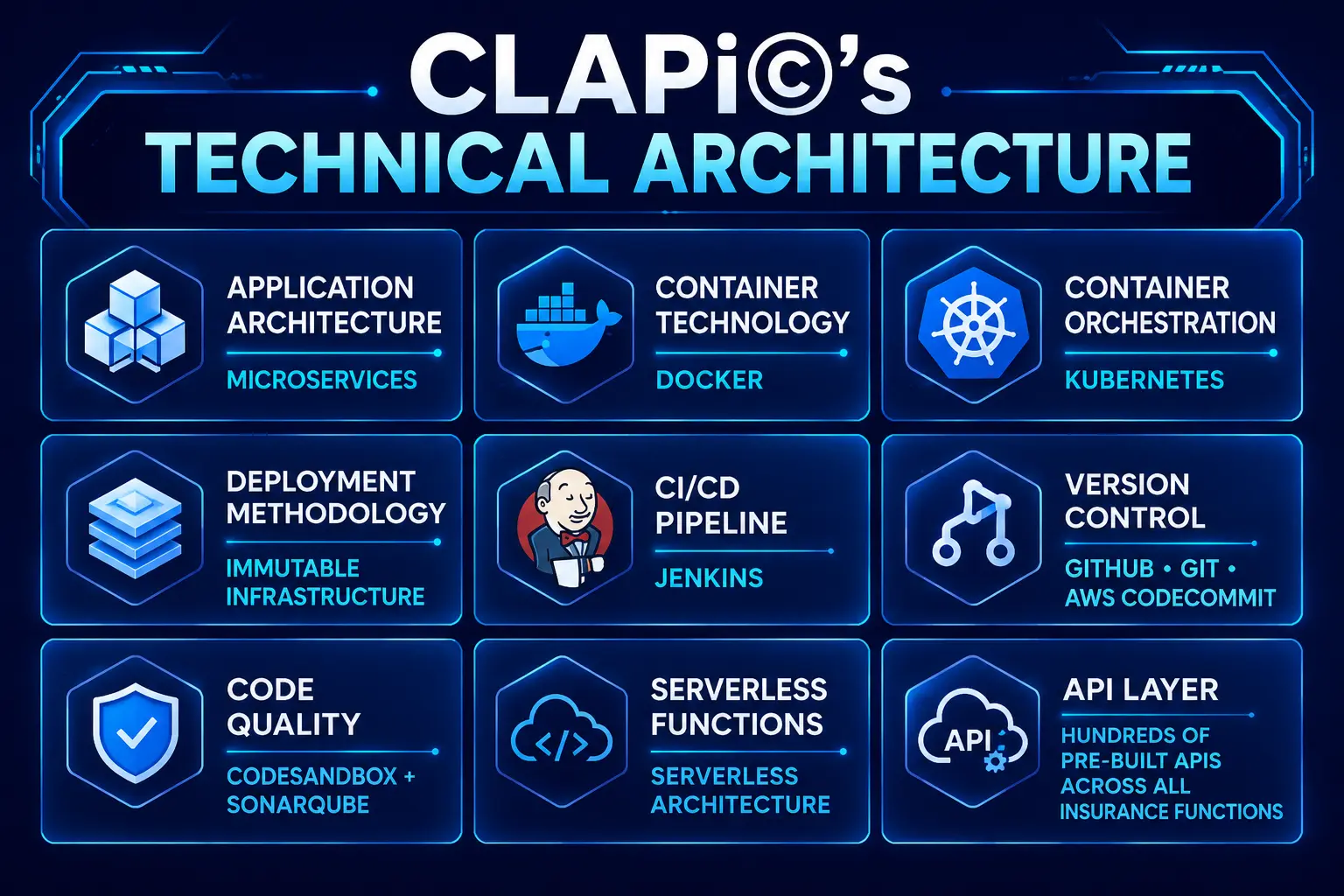
CLAPi© is built on the following technology stack, confirmed in EnoviQ’s published technical documentation:
| Architecture component | CLAPi© implementation |
|---|---|
| Application architecture | Microservices — each platform function is an independent service |
| Container technology | Docker — each microservice runs in an isolated container |
| Container orchestration | Kubernetes — Pods on Node A and Node B with automatic failover |
| Deployment methodology | Immutable infrastructure, deployed via declarative code |
| CI/CD pipeline | Jenkins — automated build, test, and deployment on every commit |
| Version control | GitHub, Git, AWS CodeCommit |
| Code quality | CodeSandbox (isolated test environment) + SonarQube (quality gates) |
| Serverless functions | Serverless architecture for event-driven processing |
| API layer | Hundreds of pre-built APIs across all insurance functions |
This architecture stack is not marketing language — it is the technical foundation that makes CLAPi©’s API-first, zero-downtime, multi-channel distribution capability possible. It is also the architecture that Celent recognised when awarding CLAPi© the XCelent Luminary designation in 2022 for Advanced Technology in Global Health Policy Administration Systems — a recognition of the platform’s technical excellence among 25 global platforms evaluated.

FAQs
API-first means the platform was designed from the ground up with the API as the primary interface — every platform function is built as a callable API before any user interface is built on top of it. In practice, this means every insurance function (quoting, issuance, claims, reinsurance, reporting) is accessible through a documented API that any external system can call. CLAPi©, whose name stands for Cloud-based API Platform for Insurance, is built on this principle.
API-first means the API is the foundational design principle — the platform was built API-first from the ground up. API-enabled means the platform has added API capability to an existing system, typically through wrappers around existing functions. The practical difference is in coverage (API-first platforms expose all functions; API-enabled platforms expose limited functions), consistency (API-first APIs follow consistent standards; wrapper APIs are often inconsistent), and performance (API-first APIs respond in real time; wrapper APIs inherit the latency of the underlying monolith).
Microservices architecture means the platform is built as a collection of independent services, each responsible for a specific function, rather than as a single monolithic application. For insurance platforms, this means individual functions (policy issuance, claims processing, reinsurance) can be scaled, updated, and deployed independently without affecting other functions. CLAPi© is built on microservices, containerised with Docker and orchestrated with Kubernetes.
Excellator is CLAPi©’s no-code, Excel-to-API product configuration tool that allows insurance product teams to configure and launch new insurance products at 10x speed without writing code. It works because CLAPi©’s Product Workspace and Rule Engine are API services.It is a direct practical benefit of the platform’s API-first design.
CLAPi© contains hundreds of pre-built APIs covering the full insurance value chain — new business, underwriting, policy administration, claims management, reinsurance, provider management, and reporting. These APIs cover all seven lines of business supported by the platform: Group Insurance, Retail Insurance, Micro Insurance, Travel Insurance, Personal Accident Insurance, Banca Insurance, and Embedded Insurance.
See CLAPi©’s API Architecture in Action
If you are evaluating insurance platforms and want to understand the practical difference that API-first architecture makes for your distribution and integration requirements, EnoviQ’s team can walk you through CLAPi©’s API layer with a live demonstration tailored to your specific use case.