Key Takeaways
- Legacy group insurance systems are the biggest barrier to insurer scalability in 2025
- A future-ready platform must support multiple LOBs — Life, Health, Travel, and Accident — on a single core
- API-first, cloud-native architecture dramatically reduces implementation time from months to weeks
- Group policy administration systems must handle Product workspace, Rating Engine, Quotation & underwriting, Policy Issuance & Servicing, claims, reinsurance, and document generation natively
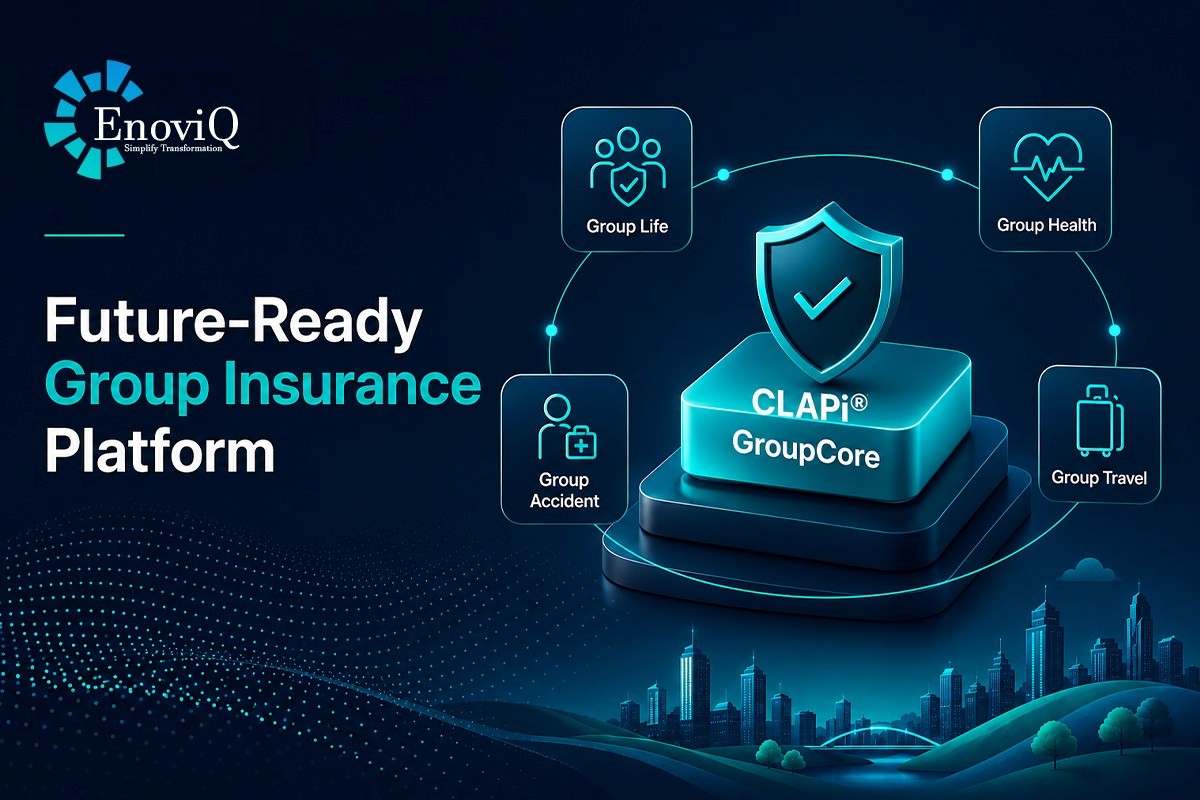
- CLAPi© GroupCore is built to make insurers live and operational in weeks, not months
The group insurance market in Asia Pacific is undergoing a fundamental shift. Insurers are under pressure to launch new products faster, serve more distribution channels simultaneously, and do all of this while managing the complexity of multiple lines of business — from group health to Group life, Group personal accident, and Group travel.
Yet for most insurers, the technology stack holding them back is the same one they've relied on for a decade. Fragmented systems, manual processes, and monolithic architectures built before cloud computing and APIs were the norm. The result: slow product launches, high operational costs, and an inability to compete with faster-moving insurtech challengers.
This guide outlines what a future-ready group insurance platform looks like — the architecture it must be built on, the capabilities it must deliver, and the questions every insurance CTO should be asking before selecting or upgrading their core system.
Why Legacy Group Insurance Systems Are Holding Insurers Back
Most group insurance core systems were designed for a world that no longer exists. They were built as standalone systems, often per product line, with no expectation that data would need to flow freely across Life, Health, Accident, and Travel products — let alone integrate in real time with distribution partners, banks, or third-party administrators.
The consequences are predictable and costly:
- Product launches that take six to twelve months instead of weeks, because every new product requires custom development rather than configuration
- Siloed data across LOBs that makes cross-sell and portfolio analytics nearly impossible.
- Manual policy administration and claims processes that increase error rates and operational headcount.
- Inability to support new distribution channels — bancassurance, embedded insurance, digital affinity platforms — without building expensive integrations from scratch.
The fundamental problem is not that insurers lack talented people. It is that the technology infrastructure makes progress disproportionately hard. The right group insurance platform technology removes this ceiling.
What a Future-Ready Group Insurance Platform Must Do
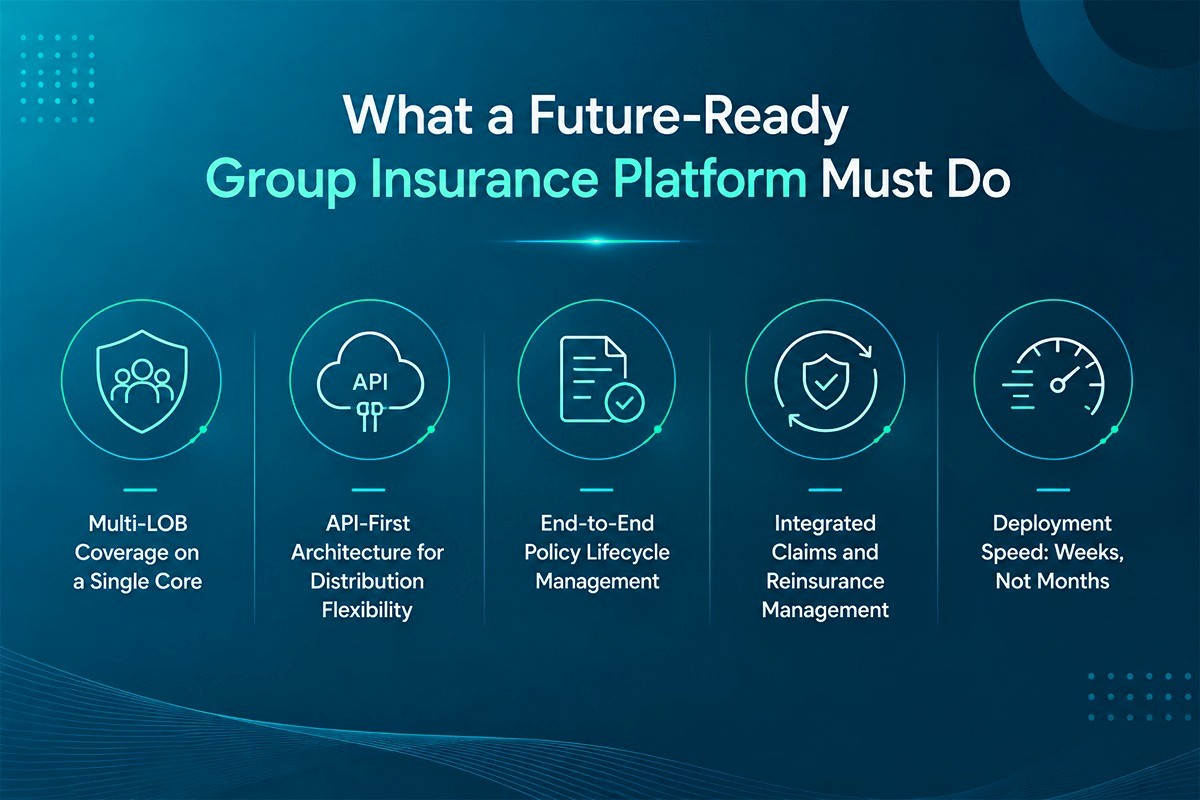
Before evaluating any vendor, insurance CTOs and product heads should define what 'future-ready' actually means for their organisation. In our experience working with insurers across Asia Pacific, a genuinely capable group insurance core system must deliver across five dimensions:
-
Multi-LOB Coverage on a Single Core
A group insurer that runs separate systems for Group Health, Group Life, Group Personal Accident, and Group Travel is not running a platform — it is running four separate silos with a shared logo. The administrative overhead alone is significant, but the strategic cost is higher: no consolidated view of the client portfolio, no ability to price or underwrite across products together, and no path to launching bundled offerings.
A future-ready multi-LOB insurance software must handle the full product spectrum from a single administrative core, with shared policy lifecycle, shared claims management, and shared reinsurance handling. Product-specific rules and rates should be configurable, not hard-coded. -
API-First Architecture for Distribution Flexibility
Distribution in group insurance has expanded dramatically. Where once an insurer relied on direct sales or a handful of brokers, today the same insurer may need to serve bancassurance partners, digital affinity platforms, TPA networks, embedded insurance channels, and self-service employer portals — all simultaneously.
An insurtech platform for insurers built on API-first principles makes this achievable without custom integration work for each new partner. Open APIs allow distribution partners to connect to the core platform, pull real-time quotes, issue policies, submit claims, and access reporting — all from their own systems or white-label portals.
Insurers that have made this transition report a significant reduction in the cost and time to onboard new distribution partners, from months to days. -
End-to-End Policy Lifecycle Management
A group policy administration system must handle the complete policy lifecycle without requiring manual handoffs between systems.This means:
- New business: quote, underwriting, proposal, policy issuance, and document generation.
- In-force management: mid-term endorsements, member additions and deletions, premium adjustments.
- Renewals: automated renewal processing with configurable rules, premium recalculation, and renewal documentation.
- Terminations: clean policy closure with final billing, claims reconciliation, and data archival.
Each of these stages generates documentation, data, and audit trails that must be managed systematically. Platforms that rely on manual steps at any of these stages introduce delay, error risk, and compliance exposure.
-
Integrated Claims and Reinsurance Management
Claims management and reinsurance are often treated as bolt-on modules in older systems. In a future-ready group insurance platform, they must be native capabilities — fully integrated with the policy record and accessible through the same interface.
Integrated claims management means first notice of loss, adjudication workflows, benefit payment processing, and claims analytics are all handled within the core platform. Integrated reinsurance management means cession schedules, bordereaux generation, and recovery tracking happen automatically as policies are issued and claims are processed — not through manual exports to a separate reinsurance system. -
Deployment Speed: Weeks, Not Months
Implementation time is one of the most overlooked criteria when insurers evaluate group policy administration systems. A platform that takes twelve to eighteen months to deploy is not future-ready — it is an expensive multi-year project before any business value is realised.
The right platform achieves fast deployment through pre-built product frameworks, a standard document and template library, ready-made connectors for payment gateways, HR systems, and reinsurance platforms, and a configuration-driven setup rather than custom code. Insurers should ask vendors directly: what is your average time to first policy issuance?
The Architecture Question: Cloud-Native and Multi-Tenant
Beyond features and modules, the underlying architecture of a group insurance platform determines its long-term scalability and cost of ownership. Two architectural choices matter most for insurers operating in or expanding across Asia Pacific.
Cloud-native deployment means the platform is built to run on cloud infrastructure, not simply 'hosted' in the cloud. It benefits from elastic scalability, built-in redundancy, and significantly lower infrastructure overhead than on-premise or legacy hosted systems.
Multi-tenant architecture allows a single platform deployment to serve multiple insurer entities, subsidiary brands, or market deployments — each with full data isolation, separate configurations, and independent workflows. For insurers expanding across markets in Asia Pacific, this is the difference between one deployment that scales and multiple standalone implementations that multiply cost and complexity.
Evaluation Checklist: Questions to Ask Before You Select a Platform
When evaluating group insurance platform technology, insurance CIOs and CTOs should push vendors on the following:
- Does the platform handle Group Life, Group Health, Group Personal Accident, and Group Travel on a single core — or are these separate modules with separate databases?
- Is the platform API-first by design, or was API capability added as an afterthought?
- What is the average time from contract signing to first policy issuance for a new client?
- How is legacy data migration handled — and what tools does the vendor provide?
- Is reinsurance management a native module, or does it require a third-party integration?
- What does multi-tenant deployment look like for an insurer with entities in multiple APAC markets?
- How are regulatory update managed — are they part of the platform roadmap, or a client responsibility?
- What pre-built connectors exist for payment gateways, HR systems, and bancassurance partners?
The depth of answers to these questions separates platforms that are genuinely future-ready from those that require significant customisation to reach the same starting point.
How CLAPi© GroupCore Addresses These Requirements
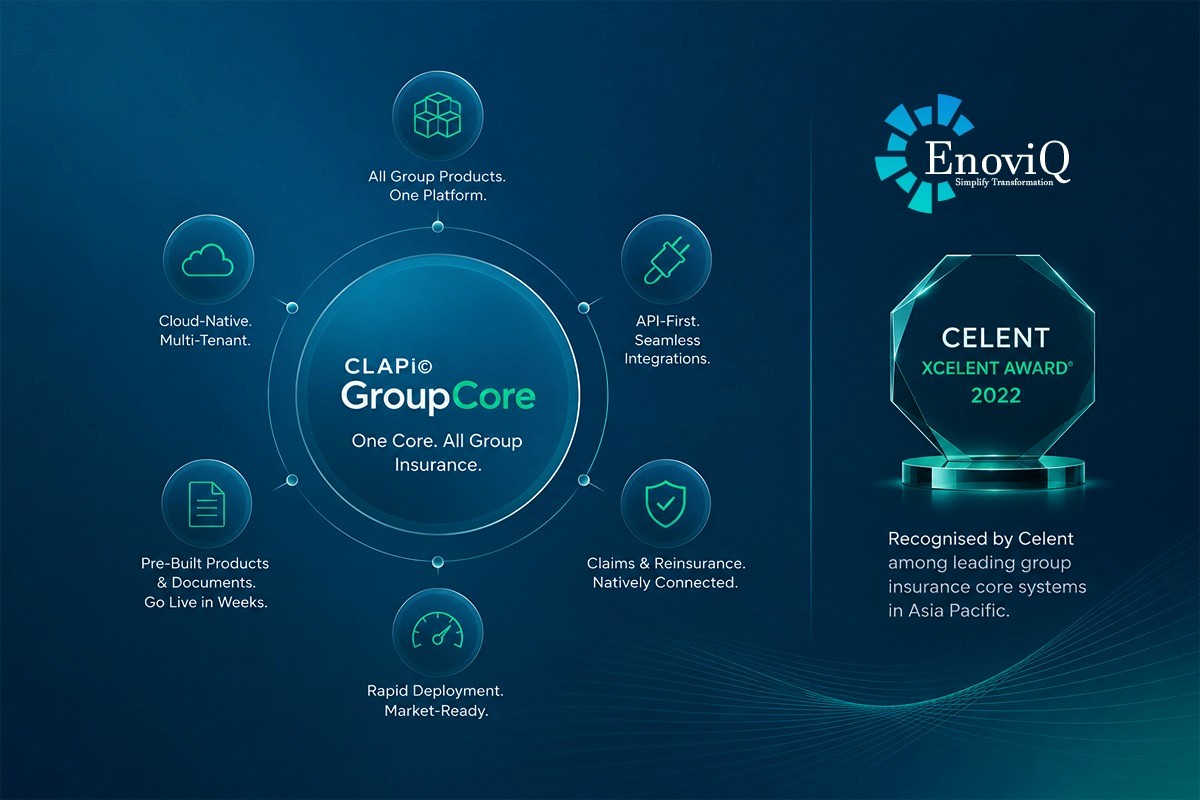
CLAPi© GroupCore, developed by EnoviQ Technologies, is designed specifically to address the multi-LOB, API-first, rapid-deployment requirements outlined in this guide. Built as a cloud-native, multi-tenant platform, GroupCore covers the full group insurance product spectrum — Group Term Life, Group Credit Life, Hospital Indemnity, Group Personal Accident, Group Travel, and Micro Insurance — from a single administrative core.
The platform's architecture is built around open APIs and pre-built input connectors, enabling insurers to connect distribution partners, HR platforms, and payment gateways without custom integration work. Claims management and reinsurance are native modules, not bolt-ons, meaning data flows automatically from policy issuance through claims settlement and reinsurance recovery without manual intervention.
EnoviQ's pre-built product frameworks and document libraries allow insurers to go live on GroupCore in weeks, not months — a critical differentiator for insurers that need to respond to market opportunities at speed.
GroupCore has been recognised by Celent with a 2022 XCelent Award, validating its position among the leading group insurance core systems in the Asia Pacific market.
FAQs
Group insurance platform technology refers to the software systems that insurers use to administer group insurance products — covering policy issuance, underwriting, claims management, reinsurance, and distribution. Modern platforms are cloud-native, API-first, and multi-tenant, supporting multiple lines of business from a single core.
Implementation timelines vary significantly depending on the platform and the insurer's requirements. Legacy implementations can take twelve to eighteen months. Modern cloud-native platforms built with pre-configured product frameworks and standard connectors — such as CLAPi© GroupCore — target go-live in weeks for standard product configurations.
A comprehensive group insurance platform should cover Group Life (term and credit life), Group Health (hospital indemnity, medical expense), Group Personal Accident, Group Travel, and Micro Insurance.
An API-first insurance platform is built from the ground up to expose its core functions — quoting, policy issuance, claims, reporting — through open APIs. This allows distribution partners, HR systems, payment gateways, and employer portals to connect directly to the insurer's core system without custom integration builds for each channel.
Multi-tenant architecture allows a single platform deployment to serve multiple entities — different subsidiary brands, markets, or regulatory environments — with full data isolation and independent configurations. For insurers expanding across APAC markets such as Singapore, Hong Kong, India, and Africa, this eliminates the cost of running separate platform instances per market.
See CLAPi© GroupCore in Action
EnoviQ's CLAPi© GroupCore is built for insurers who need to move fast without sacrificing capability. If you are evaluating group insurance platform technology or planning a core system modernisation, our team can walk you through how GroupCore handles your specific LOBs and distribution requirements.
Request a demo at enoviq.com/platform/group-insurance