Key Takeaways
- Running separate systems for Group Life, Health, Travel, and Accident multiplies cost, complexity, and data silos.
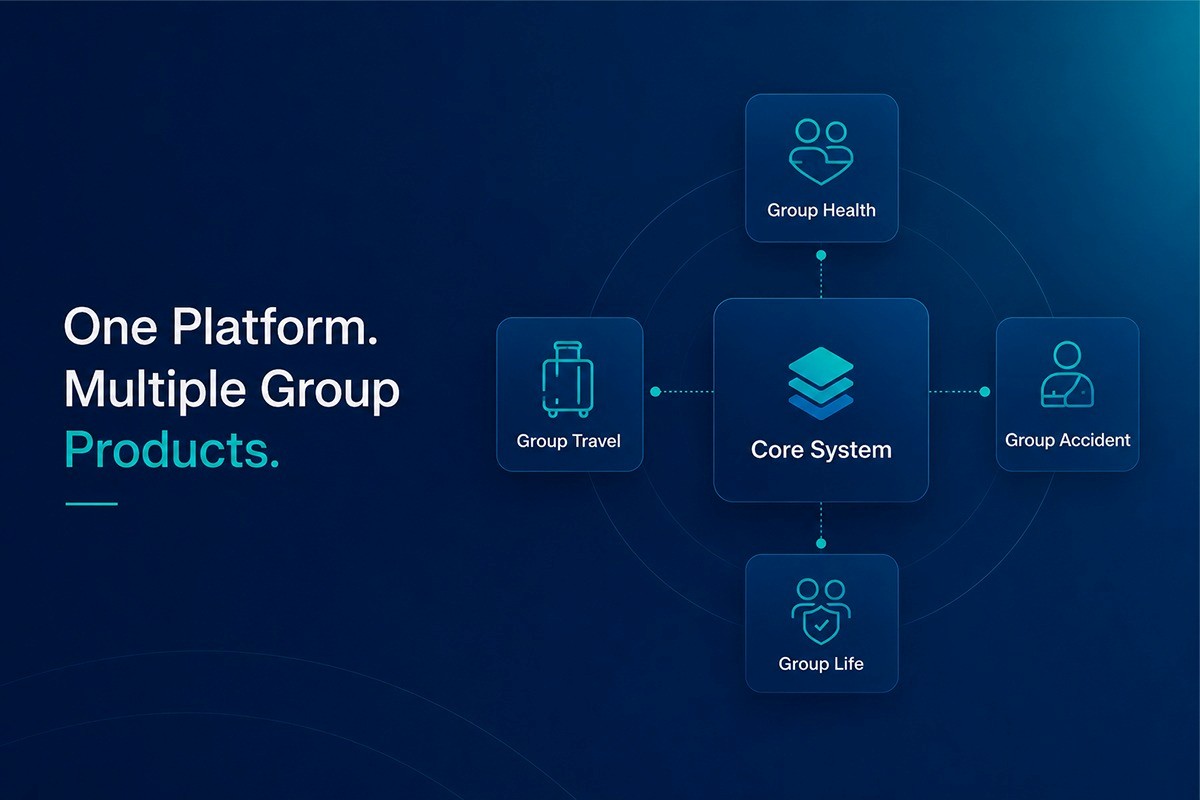
- A unified group insurance software platform must support all LOBs from a single policy core — not just a shared login.
- Each product line has unique system requirements: Group Health needs network management, Travel needs parametric triggers, Accident needs benefit schedule logic.
- Multi-product platforms reduce time-to-launch for new products from months to weeks.
- CLAPi© GroupCore supports all four group product lines natively on one core, with shared claims, reinsurance, and document management.
Most group insurers do not operate a single group insurance software platform. They operate several — one system for health, another for life, a third for travel, and perhaps a spreadsheet-driven process for personal accident. Each was built or bought to solve an immediate product need. Collectively, they have become one of the largest sources of operational friction in the business.
The cost of this fragmentation is not limited to IT maintenance. It shows up in product launch timelines that stretch to twelve months because each new product requires a separate build. It shows up in the inability to offer bundled or packaged group products because the systems cannot share data. It shows up in claims departments managing multiple portals for what is, from the client’s perspective, a single relationship.
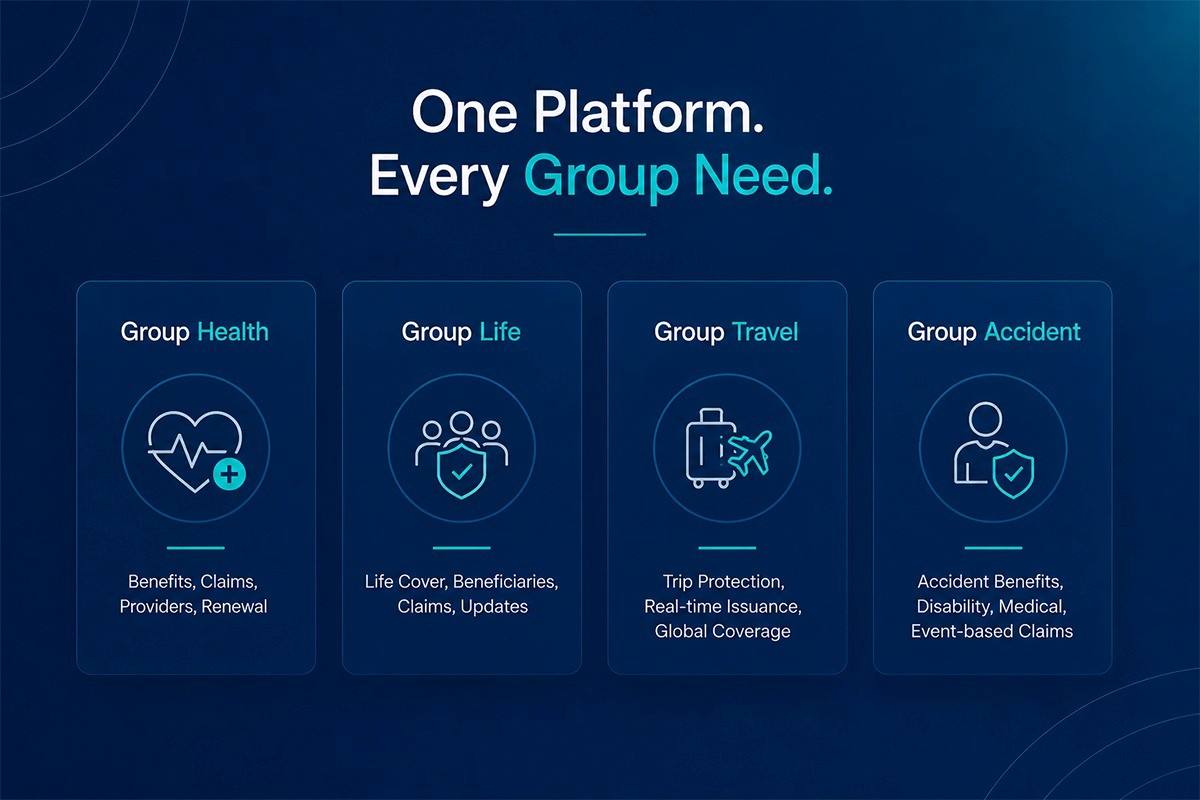
This article examines what a group insurance software platform must be capable of to genuinely support multiple product lines on a single core — and specifically what your system must handle for each of the four major group product categories: Health, Life, Travel, and Accident.
The Problem with Product-Specific Systems
The traditional approach to group insurance administration was logical at the time: when a new product was launched, a system was procured or built to manage it. Group health required claims network management. Group life required actuarial reserve calculations. Group travel required itinerary data. Each product had enough specialisation to justify its own platform.
What this approach failed to anticipate was how a group insurer’s product portfolio would grow, and how the operational overhead of managing multiple core systems would compound as each new product was added.
| Siloed Systems | Unified Platform (CLAPi© GroupCore) |
|---|---|
| Separate policy database per LOB | Single policy core across all LOBs |
| Manual data reconciliation across systems | Real-time shared data and reporting |
| Separate claims portals per product | Unified claims management interface |
| Duplicate member/group records | Single client record shared across products |
| Custom integration for each new partner | Shared API layer across all LOBs |
| Months to launch a new product | Weeks to configure and launch on existing core |
What this approach failed to anticipate was how a group insurer’s product portfolio would grow, and how the operational overhead of managing multiple core systems would compound as each new product was added.
What Each Group Product Line Requires from the Platform
A genuine multi-product group insurance platform cannot treat all LOBs as identical. Each product line has specific system requirements that the core must accommodate through configuration, not custom code. Here is what each LOB demands:
Group Health System Requirements
Group health is typically the most complex LOB for a group insurer to administer, and the most consequential to get wrong. A Group Health system must handle:
- Member enrolment and mid-term additions/deletions, including dependent management across employer groups of varying sizes.
- Benefit schedule configuration at the plan level — inpatient, outpatient, dental, optical — with sub-limits, co-payments, deductibles, and waiting periods configurable per group.
- Cashless and reimbursement claims workflows, including pre-authorisation, adjudication against benefit schedules, and direct settlement with providers.
- Network provider management if the insurer operates panel or preferred provider arrangements.
- Premium calculation based on group demographics, claims experience, and renewal adjustments — automated and auditable.
The volume of transactions in a group health book — thousands of claims per month for a mid-sized corporate portfolio — means that manual processes are not a viable long-term option. The platform must automate adjudication for straightforward claims and route only exceptions for manual review.
Group Life System Requirements
Group life products — including Group Term Life, Group Credit Life, and Group Mortgage Protection — have a different operational profile from health but are no less demanding on the platform. A Group Life system must handle:
- Master policy issuance with member certificate generation at scale, including bulk certificate production for large employer groups.
- Sum assured calculations based on salary multiples, flat amounts, or loan balances (for credit life), with automatic adjustments on member record updates.
- Beneficiary management, including nomination records, updates, and validation at the time of claim.
- Death and total permanent disability claims processing, including death certificate validation, beneficiary payment, and reinsurance recovery.
- Free cover limit monitoring and evidence of insurability workflows for members whose sum assured exceeds the group’s free cover threshold.
For bancassurance and lender-linked products such as Group Credit Life, the platform must also manage loan balance data from the originating bank or NBFC, updating sum assured automatically as loan balances reduce over time.
Group Travel System Requirements
Group travel insurance presents unique system challenges because policies are typically short-duration, high-volume, and increasingly distributed through digital and embedded channels. A Group Travel system must handle:
- Flexible policy structures: annual multi-trip, single-trip, and group journey formats with configurable geographic coverage zones.
- Real-time or near-real-time policy issuance for travel booked online or through partner booking platforms — requiring API-first integration with travel distribution partners.
- Travel-specific claims categories: trip cancellation, medical evacuation, baggage loss, travel delay, and personal accident while travelling — each with distinct documentation and adjudication requirements.
- Parametric trigger capability for flight delay products, where claims are automatically triggered and settled based on verified flight data rather than manual customer notification.
- Multi-currency premium and claims handling for international travel products.
Travel insurance is one of the product lines most rapidly being distributed through embedded insurance channels — integrated directly into airline booking platforms, travel aggregators, and corporate travel management systems. The platform’s API capability is therefore as important as its administrative functionality for this LOB.
Group Accident System Requirements
Group Personal Accident (GPA) is often offered as a standalone product or bundled with Group Life, and it has specific system requirements that differ meaningfully from both. A Group Accident system must handle:
- Benefit schedule configuration covering death, permanent total disability, permanent partial disability, and temporary total disability — with percentage-of-sum-assured benefit tables per injury type.
- Disability income payments for temporary total disability claims, including ongoing payment scheduling and return-to-work triggers.
- Accidental medical expense reimbursement as a rider or standalone benefit, with its own sub-limits and claim documentation requirements.
- Occupational class rating: GPA premiums are highly sensitive to the insured member’s occupation, and the system must support occupational class assignment and rate application at the member or category level.
- Event-based claims: GPA claims are often linked to a single accident event affecting multiple members simultaneously (for example, a workplace accident), and the system must handle multi-member claims arising from one event efficiently.
What “One Platform” Actually Means for Insurance Core System Capabilities
When vendors describe their group insurance software platform as a “unified” or “single” platform, the claim deserves scrutiny. There are three distinct levels of integration, and only one of them genuinely delivers the operational benefits of a multi-product core:
- Level 1 — Shared login only: Multiple separate systems accessible through a common portal. Data is not shared. Claims, policies, and members are duplicated across systems. This is not a unified platform — it is a shared front door to separate silos.
- Level 2 — Shared reporting layer: Separate systems with a data warehouse or reporting layer that aggregates information for management reporting purposes. Better than Level 1, but operational processes remain fragmented and data latency is significant.
- Level 3 — Shared policy core: A single policy administration engine handles all LOBs, with product-specific configuration controlling behaviour per line of business. Group, member, premium, claims, and reinsurance data are all shared and real-time. This is genuine multi-product insurance platform capability.
The difference between Level 2 and Level 3 may be invisible in a vendor demo. It becomes visible when an insurer tries to offer a bundled Group Life and Health product with unified billing, or when a claims officer needs to see a member’s full benefit position across all products in a single view.
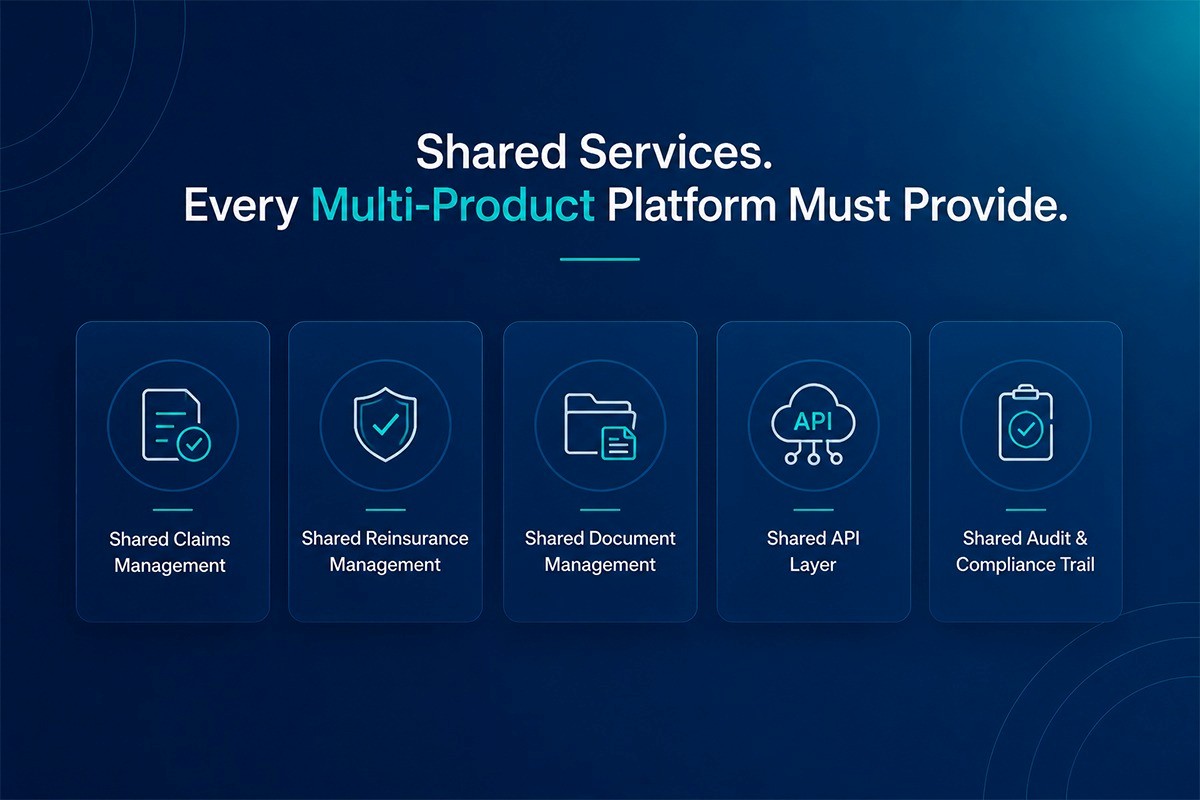
Shared Services Every Multi-Product Platform Must Provide
Beyond the product-specific requirements outlined above, a genuine multi-product group insurance software platform must provide a set of shared services that operate consistently across all LOBs:
- Shared claims management: A single claims interface and workflow engine that handles claims across all product lines, with LOB-specific adjudication rules configured within the same system.
- Shared reinsurance management: Cession schedules, treaty management, and bordereaux generation that operate across the full portfolio — not separately per product.
- Shared document management: Policy documents, certificates, endorsements, and claim settlement letters generated from a centralised template library with LOB-specific content rules.
- Shared API layer: External partners — employers, brokers, TPAs, bancassurance channels — connect once and access all products through the same integration, not separately for each LOB.
- Shared audit and compliance trail: All transactions across all products logged in a single, auditable record that satisfies regulatory reporting requirements across jurisdictions.

How CLAPi© GroupCore Handles All Four Product Lines
CLAPi© GroupCore is built as a genuine Level 3 multi-product platform — a single policy administration core that supports Group Life, Group Health, Group Personal Accident, Group Travel, Group Credit Life, and Micro Insurance products from a shared data model, shared claims management, and shared reinsurance module.
Product-specific behaviour — benefit schedules, rating tables, claims adjudication rules, document templates — is controlled through configuration, not custom code. This means that when an insurer adds a new product line or modifies an existing one, the change is made through configuration in the platform rather than a software development project.
The shared API layer across GroupCore’s full product suite means that employer portals, bancassurance partners, and TPA networks connect once and gain access to the insurer’s complete group product portfolio — with consistent data standards, consistent authentication, and consistent reporting across all LOBs.
EnoviQ’s pre-built product frameworks for each group LOB — including pre-configured benefit schedules, rate tables, and document templates — allow insurers to go live on GroupCore in weeks rather than months, regardless of which product lines they are launching first.
FAQs
A group insurance software platform is a core administration system that manages the full lifecycle of group insurance products — including policy issuance, member management, premium billing, claims processing, and reinsurance. A multi-product platform handles multiple lines of business such as Group Health, Life, Travel, and Accident from a single core.
Yes — but only if it is built as a genuinely shared policy core, not multiple separate systems with a common login. A true multi-product platform uses a single data model across all LOBs, with product-specific rules configured rather than custom-built. CLAPi© GroupCore is designed exactly this way.
Key capabilities include benefit schedule configuration per group and plan, cashless and reimbursement claims workflows, automated adjudication against benefit tables, member enrolment and mid-term management, and premium calculation based on claims experience. Integration with provider networks and employer HR systems is increasingly important for larger schemes.
When all LOBs share the same core infrastructure — policy engine, claims, reinsurance, documents, APIs — launching a new product means configuring a new product framework rather than procuring and integrating a new system. Insurers using CLAPi© GroupCore’s pre-built product frameworks can go from product design to first policy issuance in weeks.
Group Personal Accident covers death or disability resulting specifically from an accident, with benefits paid as a percentage of the sum assured based on injury type and severity. Group Life covers death from any cause (and often total permanent disability), with the full sum assured payable to beneficiaries. Both can be administered on the same platform but require different benefit schedule structures, claims documentation, and reinsurance treatment.
See How GroupCore Handles Your Product Portfolio
If you are managing Group Health, Life, Travel, or Accident on separate systems today — or planning to expand into a new product line — CLAPi© GroupCore is built to consolidate your group insurance administration onto a single, configurable core.
Our team can walk you through exactly how GroupCore handles your specific LOB mix and what a transition from your current architecture would look like.