
So, What Exactly Is Affinity Insurance?
Think of it this way: you and a thousand other people belong to the same group — maybe you all bank with the same bank, work for the same company, or are members of the same professional association. Because you're all part of the same 'family' an insurance company can offer all of you a group deal that's cheaper, faster to sign up for, and easier to manage than buying insurance individually.
That's affinity insurance in a nutshell. It's insurance sold through a common bond or affinity group — banks, NBFCs, co-operatives, associations, fintech apps, employers, or any organisation that has a large member base.
In India, this model is growing at a rapid pace. From bancassurance tie-ups (insurance sold through banks) to embedded insurance bundled inside your ride-hailing app, affinity insurance is everywhere — you just may not have noticed it by that name.
Quick Fact: India's insurance penetration is still around 4% of GDP — one of the lowest among large economies. Affinity insurance is seen as the fastest scalable route to cover the remaining 96%.
How Does Affinity Insurance Actually Work?
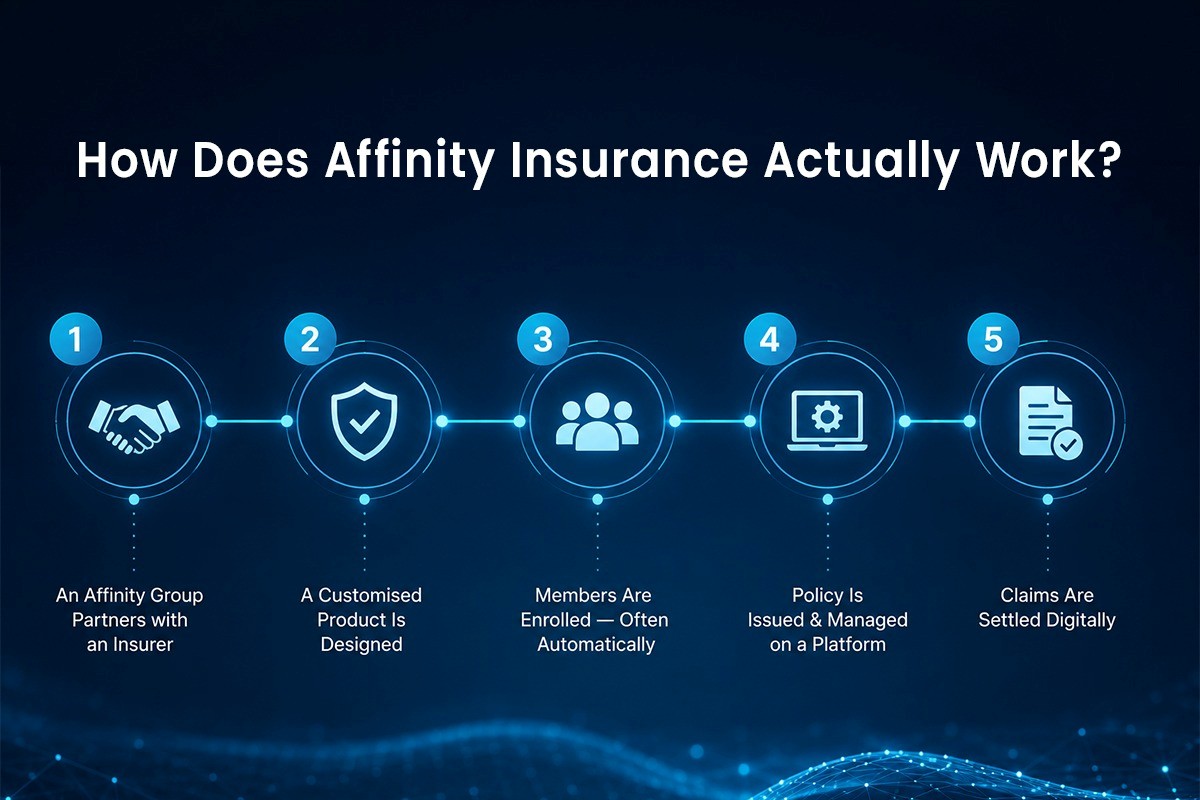
The process is simpler than you might think. Here's how it flows from start to finish:
-
An Affinity Group Partners with an Insurer
A bank, employer, cooperative, or any large organisation ties up with an insurance company. They become the distribution partner — they don't underwrite the risk, they just help sell or bundle the policy.
-
A Customised Product Is Designed
A tailored insurance scheme is built for that specific group — covering relevant risks, at relevant price points. A teachers' union, for example, might get a scheme focused on health and accident cover.
-
Members Are Enrolled — Often Automatically
Members opt in (or are sometimes auto-enrolled) with minimal paperwork. No long medical tests, no complicated forms. Just quick, digital onboarding.
-
Policy Is Issued & Managed on a Platform
A smart insurance platform (like CLAPi© AffinitiQ) handles all the backend work — policy issuance, renewals, endorsements, and claims — in real time.
-
Claims Are Settled Digitally
When something goes wrong, the claim is filed digitally. AI-powered tools speed up verification and settlement — meaning members get their money faster.
Why Is Affinity Insurance a Big Deal in India?
India has a massive protection gap. Hundreds of millions of people either don't have insurance or are severely underinsured. The traditional model of individual agents selling policies one by one just can't scale fast enough to cover this gap.
Affinity insurance solves this by piggybacking on trust and existing relationships. When your bank or employer offers you insurance, you're more likely to take it than if a random agent calls you. And because the risk is spread across a large group, the premiums are significantly lower.
Here's what makes it work so well for everyday people:
- Lower Premiums — Group pricing means you pay far less than you would for the same cover bought individually.
- Instant Enrollment — No lengthy paperwork. Sign up in minutes through your bank app, employer portal, or mobile platform.
- Trusted Distribution — Bought through an organisation you already trust — your bank, employer, or co-op society.
- Relevant Coverage — Products are tailored to the specific needs and risks of the group, not a one-size-fits-all plan.
- Digital-First — From purchase to claim, everything happens on your phone or computer. No physical visits needed.
- Wider Reach — Reaches tier-2 and tier-3 cities where traditional insurance agents have low penetration.
Real-Life Examples of Affinity Insurance in India
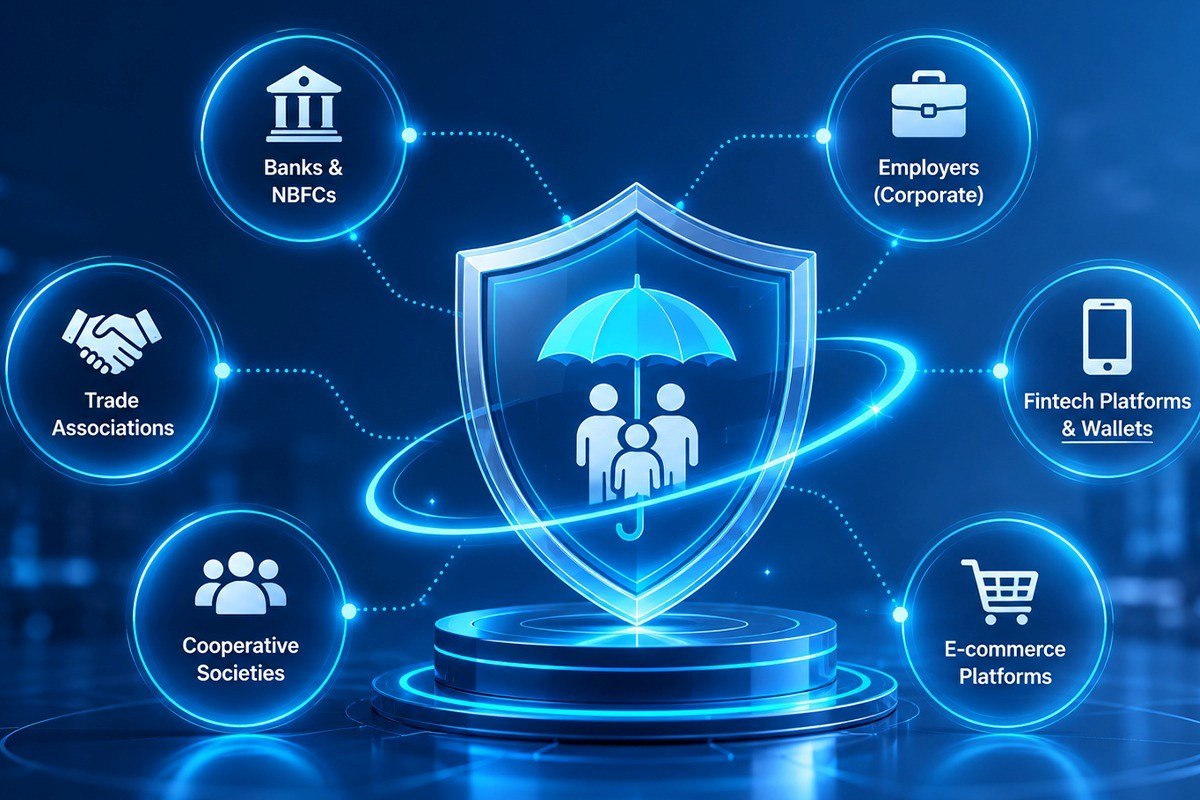
You've probably come across affinity insurance without even knowing it. Here are some common examples:
- Banks & NBFCs offer home loan insurance, credit life cover, and personal accident policies — usually bundled at account opening or loan disbursal.
- Employers (Corporate) provide group health insurance and group term life as part of the employee benefits package.
- Trade Associations offer fire, burglary, and public liability cover to small business members at subsidised rates.
- Fintech Platforms & Wallets embed micro-insurance, travel cover, and device protection directly inside their app at checkout or during a transaction.
- Cooperative Societies extend crop insurance, life cover, and accident insurance to all members at group rates.
- E-commerce Platforms offer product warranty and transit insurance as optional add-ons at the time of purchase.
What Is an Affinity Insurance Platform & Why Does It Matter?
Here's the thing — managing insurance for thousands or even millions of members across multiple partners is incredibly complex without the right technology. This is where affinity insurance platforms and insurance management software come in.
Platforms like CLAPi© AffinitiQ are built specifically for this. They handle everything from partner onboarding and product configuration to real-time policy issuance, renewals, and AI-powered claims processing. Think of it as the engine running silently behind all those seamless digital insurance experiences.
A good affinity platform connects insurers, distribution partners, and policyholders on a single digital ecosystem — so a bank can sign up to sell insurance and start distributing within weeks, not months. Every policy, every claim, every renewal is tracked in real time.
For insurers in India looking to scale bancassurance distribution, group insurance management, or embedded insurance programs, having the right technology backbone is the difference between growing at 10x and being stuck in spreadsheet hell.
Is Affinity Insurance Regulated in India?
Yes — IRDAI (Insurance Regulatory and Development Authority of India) regulates all insurance products in India, including those sold through affinity channels. Distribution partners like banks and NBFCs need to be registered as corporate agents or work under specific regulatory frameworks.
IRDAI has been actively pushing for insurance inclusion and has introduced several frameworks to make affinity and group insurance easier to implement — particularly for reaching underserved populations in rural and semi-urban India.
Good affinity insurance platforms are built with regulatory compliance baked in — including e-KYC, e-sign, audit trails, and multi-language support — so partners can operate confidently without worrying about compliance gaps.
The Future of Affinity Insurance in India
With India's digital insurance market expanding rapidly and smartphone penetration crossing 700 million users, the conditions are perfect for affinity insurance to grow exponentially. Here's what's coming:
- Embedded Insurance at Scale — Insurance will increasingly be invisible, bundled into every loan, every flight ticket, every gadget purchase. You won't 'buy' insurance separately; it'll just be there when you need it.
- AI-Driven Claims for Faster Settlements — OCR-based document verification, fraud detection, and straight-through processing will make insurance claim settlement a matter of hours, not weeks.
- Micro-Insurance for Bharat — Affinity models will be the primary vehicle for delivering micro-insurance to farmers, gig workers, and low-income households through their community organisations or digital platforms.
- Real-Time Partner Analytics — Insurance companies and their distribution partners will use live dashboards to track conversion, renewal rates, and claim ratios — turning insurance distribution into a data-driven business like never before.
FAQs
Group insurance is typically offered by an employer to its employees as a workplace benefit, like a company providing health insurance to all its staff. Affinity insurance is a broader concept where insurance is distributed through any common-interest group — banks, trade associations, fintech apps, cooperatives, and more. All employer group insurance is a form of affinity insurance, but not all affinity insurance is group insurance. The key idea in both cases: you benefit from being part of a larger group.
Yes, in most cases. Because the risk is spread across a large number of people within the group, insurance companies can offer significantly lower premiums than individual policies. Distribution costs are also lower, and those savings often get passed on to you as the member. That said, coverage amounts and terms may differ from a fully customised individual policy — so it's always good to compare before deciding.
Absolutely. Affinity insurance is real insurance underwritten by a licensed insurer. Whether you got it through your bank account, a fintech app, or a trade association, the claim process works the same as any other policy. You'll need to contact the insurer or the partner's helpdesk, submit the required documents, and your claim will be processed. Increasingly, this is done digitally — submit documents on an app and track your claim status in real time.
An affinity insurance platform is a software system that manages the entire insurance distribution process — from onboarding partner organisations and configuring products, to issuing policies, handling renewals, processing claims, and generating analytics. It's used by insurance companies, banks, NBFCs, fintech platforms, corporate agents, and broker firms. Platforms like EnoviQ's CLAPi© AffinitiQ are designed to let insurers and their distribution partners go live with new affinity programs in weeks, with minimal IT effort.
Yes, completely. All insurance in India — whether individual or group/affinity — is regulated by IRDAI (Insurance Regulatory and Development Authority of India). The insurer underwriting the product must be IRDAI-licensed, and the distribution partner must operate as a registered corporate agent or under an approved framework. So if you've been offered insurance through your bank or employer, it is legally backed, regulated, and safe. Always check that you receive a policy document confirming your coverage.