Key Takeaways
- Insurance policy administration software is the core technology decision that determines an insurer’s operational speed, product agility, and distribution capability.
- APAC insurers face a specific set of requirements: multi-market regulatory compliance, multi-currency and multi-language support, and distribution through diverse channels from bancassurance to embedded digital.
- The shift from monolithic on-premise systems to cloud-native, API-first platforms is the defining technology trend in insurance administration today.
- Evaluation criteria must go beyond features to cover architecture, deployment model, implementation speed, and vendor track record in the region.
- EnoviQ’s CLAPi© platform — covering GroupCore, EEQ, and AffinitiQ — is purpose-built for the APAC insurance administration requirements outlined in this guide.
The selection or replacement of an insurance policy administration software platform is the most consequential technology decision an insurer makes. Unlike peripheral systems — CRM, reporting, document management — the policy administration system is the operational core of the insurance business. Every product launch, every policy issued, every claim processed, every premium collected flows through it.
For insurers in Asia Pacific, this decision is made more complex by the specific characteristics of the region: diverse regulatory environments across Singapore, Hong Kong, India, Indonesia, Malaysia, and Africa; distribution models that span bancassurance, affinity, broker, digital, and embedded channels; product portfolios covering Group Life, Group Health, Personal Accident, Travel, and increasingly micro insurance; and a competitive landscape that now includes well-capitalised insurtech challengers operating on modern technology from day one.
This guide sets out the evaluation framework that APAC insurers should apply when assessing insurance policy administration software — whether they are replacing a legacy system or selecting a platform for a new product line.
What Insurance Policy Administration Software Must Do
At its core, a policy administration system (PAS) is responsible for managing the complete lifecycle of every insurance policy from issuance to claim settlement. For an APAC insurer operating multiple lines of business, this means the system must handle:specialisation to justify its own platform.

- New business: quote generation, underwriting assessment, proposal processing, policy issuance, and document generation across all product lines.
- Endorsements: mid-term endorsements, member or insured additions and deletions, coverage changes, and premium adjustments throughout the policy term.
- Renewals: automated renewal processing with experience-based or community-rated premium recalculation, renewal documentation, and lapse management.
- Claims: first notice of loss, adjudication against policy terms, benefit payment processing, subrogation and recovery, and claims analytics.
- Reinsurance: cession calculations, treaty management, bordereaux generation, and recovery tracking across the insurer’s full reinsurance programme.
- Distribution management: commission calculations, partner performance reporting, and distribution channel analytics across all channels.
The breadth of these requirements explains why policy administration software selection is such a consequential decision — and why the wrong choice imposes operational constraints that compound over years rather than resolving themselves.
The Architecture Question: Why It Matters More Than Features
The most important dimension of insurance policy administration software evaluation is not the feature list. It is the underlying architecture. Two platforms can appear similar in feature coverage while being fundamentally different in their ability to scale, integrate, and evolve.
-
Cloud-Native vs Hosted Legacy
A cloud-native platform is built from the ground up to run on cloud infrastructure, benefiting from elastic scalability, built-in redundancy, and continuous deployment of updates. A legacy system ‘hosted in the cloud’ is simply an old architecture running on rented infrastructure — it does not benefit from cloud-native design principles and typically still requires scheduled maintenance windows, manual upgrade projects, and fixed infrastructure sizing.
For APAC insurers, cloud-native deployment is increasingly a baseline requirement rather than a differentiator. Regulators across the region have issued cloud adoption guidelines, and the operational advantages of genuine cloud-native platforms — lower infrastructure cost, faster feature delivery, built-in disaster recovery — make the alternative increasingly difficult to justify.
-
API-First vs Integration Middleware
An API-first policy administration system exposes all of its core functions through open, documented APIs. This is what makes it possible to connect distribution partners, employer HR systems, payment gateways, and digital channels without custom integration projects for each connection.
Legacy systems that added API capability as an afterthought typically expose only a subset of their functions through APIs, require integration middleware to translate between systems, and impose constraints on what data can be shared and at what speed. For a cloud insurance platform serving multiple distribution channels simultaneously, this is a critical limitation.
-
Multi-Tenant vs Single-Tenant Architecture
Multi-tenant architecture allows a single platform deployment to serve multiple entities — subsidiary brands, market deployments, distribution partners — with full data isolation and independent configurations per tenant. For APAC insurers operating across multiple markets, this is the architecture that makes regional expansion affordable. A single-tenant architecture requires a separate deployment per entity, multiplying infrastructure and maintenance costs with every new market or brand.
APAC-Specific Requirements That Global Platforms Often Miss
Global insurance policy administration software platforms designed primarily for European or North American markets often struggle with the specific requirements of the APAC insurance landscape. Insurers evaluating global vendors should probe specifically on the following:
-
Multi-Regulatory Compliance
The regulatory requirements of MAS (Singapore), IRDAI (India), IA and SFC (Hong Kong), OJK (Indonesia), and other APAC regulators differ significantly. A platform serving multiple APAC markets must support jurisdiction-specific product approval workflows, disclosure requirements, sales documentation, and supervisory reporting — configurable per market without custom development.
-
Multi-Currency and Multi-Language Support
APAC insurance operations span currencies from Singapore dollars to Indian rupees to Indonesian rupiah, and customer communications must be delivered in English, Mandarin, Bahasa, Hindi, and other regional languages. A platform that handles multi-currency and multi-language as an afterthought rather than a core design principle will require workarounds that add cost and complexity.
-
Bancassurance and Affinity Distribution Capability
Bancassurance is the dominant distribution channel across much of APAC. A policy administration system that does not natively support white-label bancassurance distribution, real-time policy issuance through bank partner interfaces, and multi-partner commission management is not fit for purpose in the APAC market.
-
Group Insurance Depth
Group Life, Group Health, Group Personal Accident, and Group Travel are major product categories across APAC — yet many global platforms have shallow group insurance capability designed for simple employer-sponsored schemes rather than the complex multi-LOB group portfolios that APAC insurers manage. Platform depth in group insurance is a non-negotiable evaluation criterion.
Evaluation Criteria: The Questions to Ask Every Vendor
When evaluating insurance policy administration software for an APAC insurance operation, the following questions should be applied to every vendor under consideration:
| Evaluation area | Questions to ask |
|---|---|
| Architecture | Is this cloud-native or hosted legacy? Is the API layer built-in or middleware? Is the deployment model multi-tenant? |
| LOB coverage | Which lines of business are natively supported? Are Group Health, Life, PA, and Travel on the same core or separate modules? |
| APAC compliance | Which APAC regulatory frameworks are supported? How are regulatory updates managed — vendor responsibility or client? |
| Implementation speed | What is the average time from contract to first policy issuance? What pre-built frameworks accelerate deployment? |
| Distribution | Is bancassurance distribution natively supported? What does white-label capability actually mean in the platform? |
| Migration | How is legacy data migrated? What tooling does the vendor provide? Is progressive migration supported? |
| Track record | What is the vendor’s APAC client base? Which markets have they deployed in? Do they have independent analyst recognition? |
How Modern Insurance Policy Administration Platforms Address These Requirements
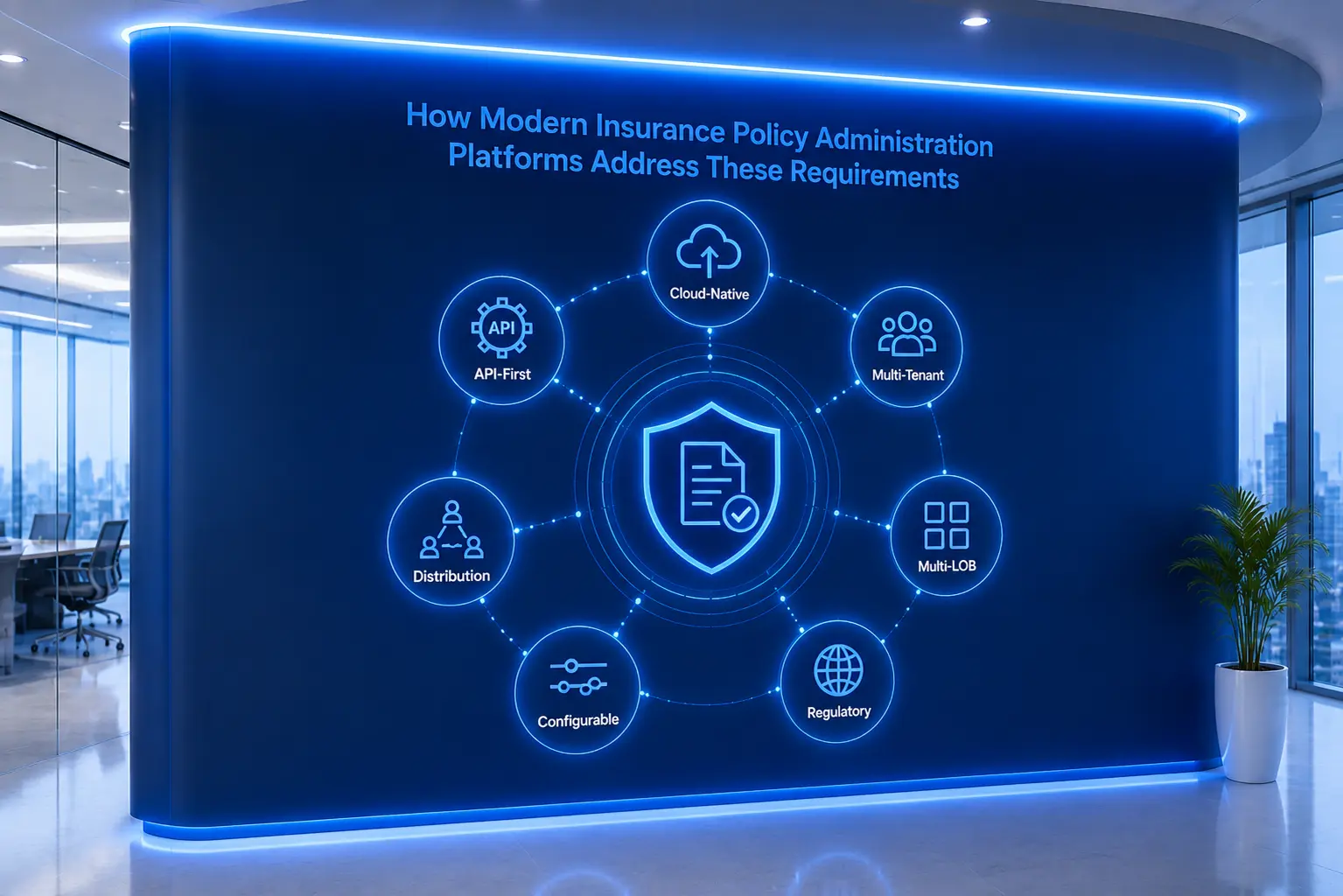
Modern insurance policy administration platforms for APAC insurers must combine flexible architecture, broad line-of-business support, and strong distribution capabilities. Insurers should look for platforms that offer:
- Cloud-native deployment for scalability, resilience, and faster updates.
- API-first architecture to enable seamless integration with distribution partners, HR systems, payment gateways, and digital channels.
- Multi-tenant capabilities to support multiple business units, markets, and partners from a single platform.
- Multi-LOB support across Group Life, Group Health, Personal Accident, Travel, and other insurance products.
- Configurable workflows that allow insurers to launch and modify products quickly.
- Support for bancassurance, affinity, and embedded insurance distribution models.
- Multi-country regulatory compliance, multi-currency, and multi-language capabilities for APAC operations.

FAQs
Insurance policy administration software (PAS) is the core system that manages the full lifecycle of insurance policies — from issuance and in-force management through claims processing and policy termination. It is the operational foundation of an insurance company, handling every product across every line of business.
A cloud-native platform is built from the ground up to run on cloud infrastructure, with elastic scalability, built-in redundancy, and continuous feature delivery. A hosted platform is a legacy architecture running on rented cloud infrastructure — it does not benefit from cloud-native design and typically still requires scheduled maintenance windows and manual upgrade projects.
Legacy core system replacements on conventional platforms typically take twelve to twenty-four months. Modern cloud-native platforms with pre-built product frameworks, standard data migration tooling, and configuration-driven setup can achieve first-product go-live in weeks, with full portfolio migration completed progressively over a shorter overall timeline
CLAPi© is deployed across markets in Asia Pacific and Africa, with regulatory compliance configurations covering frameworks including IRDAI (India), MAS (Singapore), IA and SFC (Hong Kong), and OJK (Indonesia). Market-specific regulatory requirements — product approval workflows, disclosure requirements, supervisory reporting — are managed through platform configuration rather than custom development.
CLAPi© is purpose-built for APAC insurance requirements — group insurance depth, bancassurance distribution, multi-market regulatory compliance, and multi-currency/multi-language support are core platform capabilities rather than add-ons. Global platforms designed primarily for European or North American markets often require significant customisation to meet APAC operational and regulatory requirements.
Evaluate CLAPi© for Your Policy Administration Requirements
If you are evaluating insurance policy administration software for a new product line or planning a core system replacement, EnoviQ’s team can walk you through how CLAPi© addresses your specific APAC requirements across group insurance, employee benefits, and affinity distribution.