
Key Takeaways
- Reinsurance in CLAPi©’s core platform — a native capability, not a bolt-on or third-party integration.
- Most legacy insurance systems treat reinsurance as an afterthought, resulting in manual cession calculations, spreadsheet-based bordereaux, and slow recovery processing.
- A core platform must handle proportional and non-proportional treaty management, automatic cession, and bordereaux generation natively.
- Policy and Claims data feed directly comes into Reinsurance — the integration must be seamless, not bridged.
- Separate specialist reinsurance systems are justified only for complex reinsurance programmes that exceed the scope of a core platform’s native capability.
Reinsurance management is one of the most consistently underserved functions in insurance platform design. It is technically complex, operationally critical, and frequently treated as an afterthought in the selection of a core policy administration system — only to become a source of significant operational cost and error when the platform is in production.
The question most insurers face is not whether their platform needs reinsurance capability, but how much reinsurance capability should sit within the core platform and when does the complexity of a reinsurance programme justify a specialist standalone system.
This article draws the line between those two cases — and explains what CLAPi©’s native Reinsurance module covers, how it integrates with Policy and Claims Management within the same platform, and the specific situations in which a separate reinsurance system is genuinely warranted.
Why Legacy Systems Get Reinsurance Wrong
The operational failure pattern for reinsurance in legacy insurance systems is well known to any reinsurance manager who has worked with them. It looks like this:
- Policy data lives in the core system. Premium accounting lives in a separate finance system. Claims data lives in a third system. Reinsurance calculations require data from all three — and none of them talk to each other in real time.
- The reinsurance team exports data from each system on a monthly cycle, reconciles the extracts in spreadsheets, calculates cessions manually, and produces bordereaux by combining the results.
- Errors in the source data — policy endorsements not reflected in the claims system, mid-term adjustments not captured in the premium accounting module — propagate into the reinsurance calculation and are only discovered during quarter-end reconciliation or reinsurer audit.
- Recovery processing on claims is tracked separately from the claims system, creating a persistent reconciliation gap between gross claims paid and net claims after recovery.
Each of these failures has a common root cause: reinsurance was not designed into the core platform. It was bolted on, bridged by manual processes, or outsourced to a spreadsheet. The consequence is a reinsurance function that absorbs significant operational resource for tasks that should be automated.
What a Core Platform Must Handle Natively for Reinsurance
-
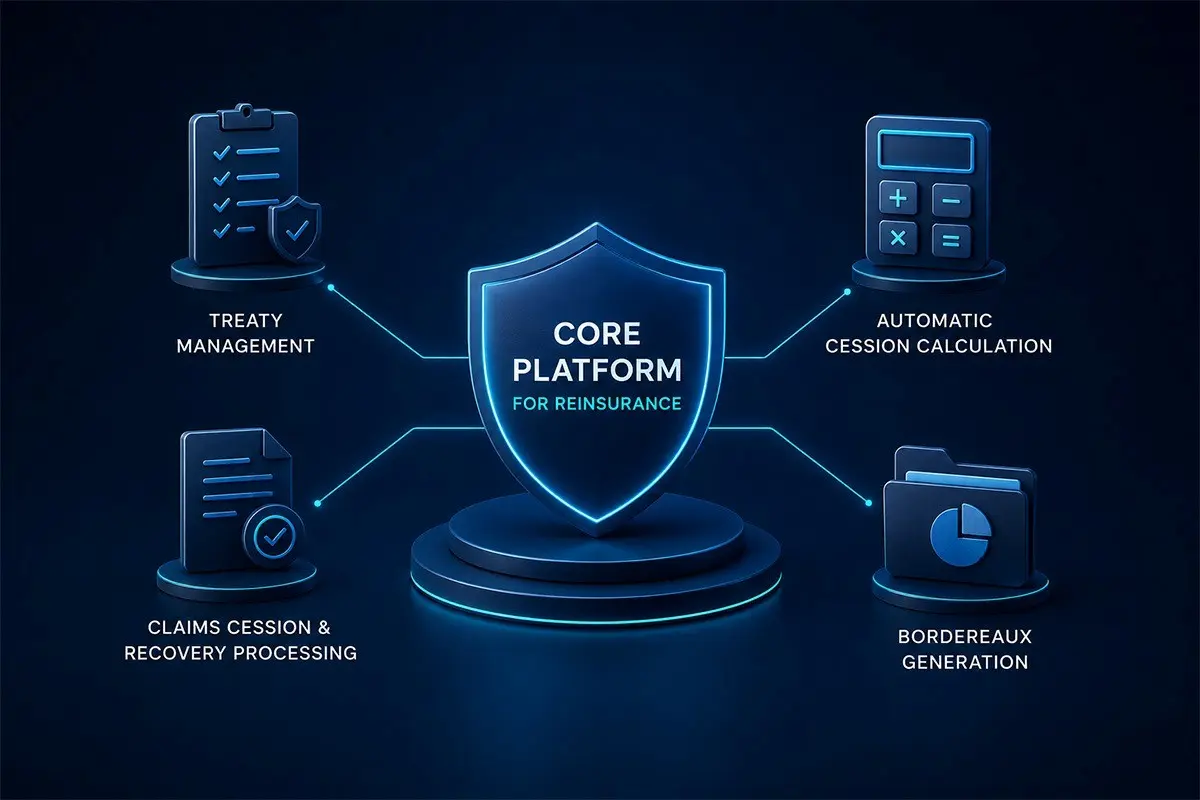
Treaty Management
The foundation of reinsurance administration is treaty management: capturing the terms of each reinsurance treaty (proportional quota share, surplus, or non-proportional excess of loss) and applying them automatically to the insurer’s policy and claims data. A core platform must allow reinsurance treaties to be configured in the system — with treaty terms, cession percentages, retention limits, and effective dates — and applied automatically without manual calculation.
CLAPi©’s Reinsurance module supports both proportional (quota share and surplus) and non-proportional (excess of loss, Stop loss) treaty structures, configurable within the platform’s Rule Engine. Treaty configurations are applied automatically to all in-scope policies as they are issued, without manual intervention.
-
Automatic Cession Calculation
Cession — the allocation of risk from the insurer to the reinsurer under each treaty — must be calculated automatically as policies are issued and claims are processed. On a native reinsurance platform, the cession calculation happens in real time: when a policy is issued in the Policy Administration module, the system immediately calculates the reinsurer’s share based on the applicable treaty and records the cession in the reinsurance ledger.
The direct connection between CLAPi©’s Policy Administration, Policy Accounting, and Reinsurance means that cession data is always current and always consistent with the policy record. There is no extraction, reconciliation, or manual step between policy issuance and reinsurance accounting.
-
Claims Cession and Recovery Processing
When a claim is processed in CLAPi©’s Claims Management / TPA module, the reinsurer’s share of the claim is calculated automatically based on the cession structure of the underlying policy. Recovery amounts are recorded in the reinsurance ledger and tracked through to receipt — giving the reinsurance team real-time visibility of outstanding recoveries without manual tracking.
The integration between Claims Management and Reinsurance within CLAPi©’s core platform means that gross claims and net claims (after reinsurance recovery) are always reconciled within the system, eliminating the manual reconciliation that consumes significant resource in legacy environments.
-
Bordereaux Generation
Bordereaux — the periodic data submissions to reinsurers summarising ceded premium and claims — must be generated automatically from the platform’s policy and claims data. CLAPi©’s Reinsurance module generates bordereaux automatically based on treaty requirements, with configurable output formats to meet different reinsurers’ submission requirements.
Because the bordereaux data is drawn directly from the platform’s policy, accounting, and claims records — not from manual extracts or spreadsheet reconciliations — the bordereaux are always consistent with the insurer’s own records and audit-ready.
How Modules - Policy Admin, Claims, Policy Accounting and Reinsurance Work Together in CLAPi©
| Module | Reinsurance data flow |
|---|---|
| Policy Administration | Policy issued → cession calculated automatically against applicable treaty → ceded premium recorded in Reinsurance module |
| Policy Accounting | Premium accounting confirms net premium (after cession) → reconciles with reinsurance module in real time |
| Claims Management / TPA | Claim processed → reinsurer’s share calculated → recovery recorded → gross and net claims reconciled in reinsurance module |
| Reinsurance | Central ledger: treaty configurations, cession records, premium bordereaux, claims bordereaux, recovery tracking, reinsurer statements |
This integrated flow means that every reinsurance record in CLAPi© has a direct, traceable link to the underlying policy and claims data. Reinsurers auditing the insurer’s records can be taken from a bordereaux line item directly to the policy record and the claims record that support it — with no manual reconciliation required.
When a Separate Reinsurance System Is Justified
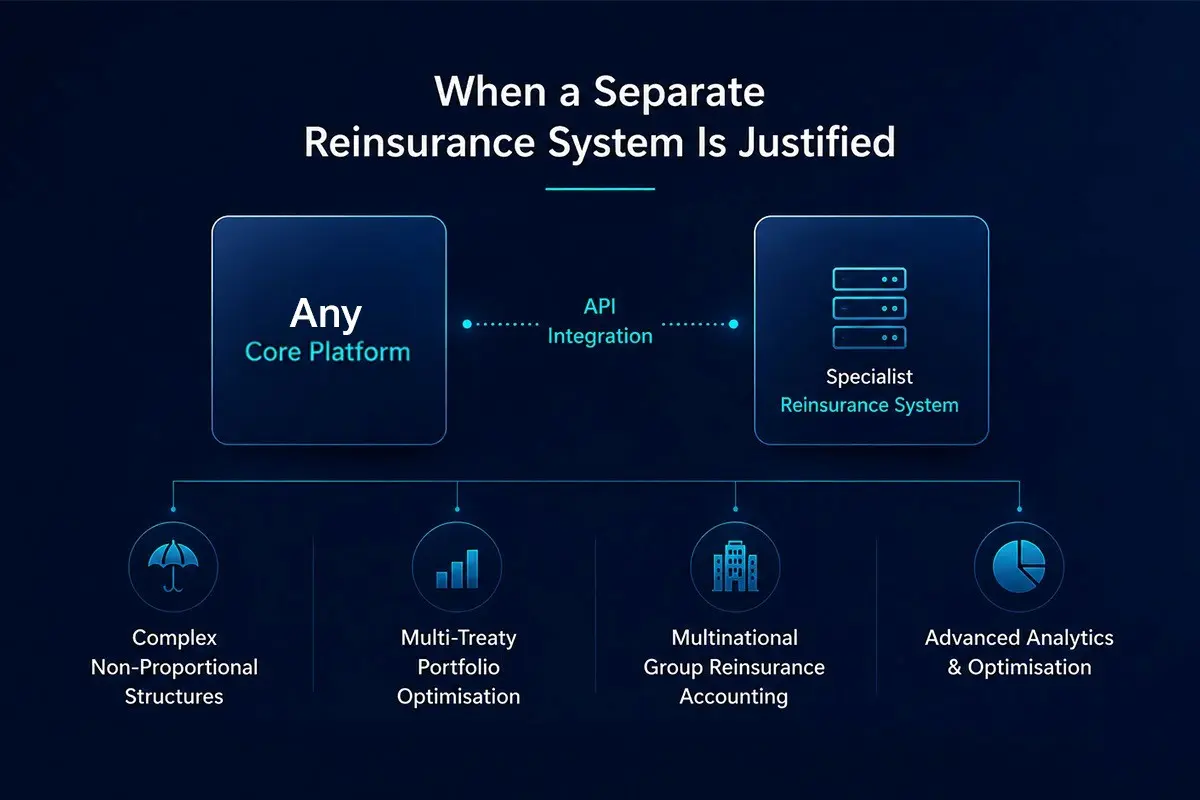
CLAPi©'s native Reinsurance module handles the reinsurance requirements of the majority of group and health insurers operating in Asia Pacific. CLAPi© is designed to operate in both coupled and decoupled modes — meaning insurers can run it as a fully standalone system or integrate it with specialist external systems through its API layer, depending on their complexity and requirements.
There are specific situations where the complexity of a reinsurance programme genuinely warrants a specialist standalone reinsurance system alongside CLAPi©:
- Complex non-proportional structures: Stop-loss programmes, catastrophe excess of loss with complex reinstatement provisions, and aggregate excess of loss structures with multi-year development periods.
- Multi-treaty portfolio optimisation: Insurers actively managing a large portfolio of reinsurance treaties across multiple reinsurers and geographies may benefit from specialist analytics tools.
- Reinsurance accounting for multinational groups: Insurers with complex intra-group reinsurance arrangements across multiple legal entities and jurisdictions may require specialist multi-entity and multi-currency consolidation capability.
In each of these cases, CLAPi© handles operational reinsurance administration (cession, bordereaux, recovery) while the specialist system manages the specific complex capability required — with CLAPi© providing the data feed through its API layer

FAQs
Reinsurance management software handles the administration of an insurer’s reinsurance programme — including treaty configuration, cession calculation, bordereaux generation, recovery tracking, and reinsurer accounting. It can be a native module within an insurance core platform (as in CLAPi©) or a standalone specialist system for complex programmes.
Proportional reinsurance (quota share, surplus) allocates a defined percentage of every risk to the reinsurer. Non-proportional reinsurance (excess of loss) covers losses above a defined retention. CLAPi©'s Reinsurance module supports both structures through the platform's Rule Engine, with treaty terms configurable for both proportional cession percentages and non-proportional retention and limit structures.
CLAPi© generates bordereaux automatically from the platform's policy, accounting, and claims data — no manual extraction or spreadsheet reconciliation required. Bordereaux output formats are configurable to meet different reinsurers' submission requirements. Because the data is drawn directly from the platform's operational records, bordereaux are always consistent with the insurer's own data and audit-ready.
Reinsurance is Module 08 in CLAPi©'s core module set — not an add-on. It is a native capability that integrates directly with Policy Administration, Policy Accounting, and Claims Management / TPA. This native integration is what enables automatic cession calculation, real-time gross-to-net reconciliation, and audit-ready bordereaux without manual data bridging.
A specialist reinsurance system alongside CLAPi© is warranted when the insurer's reinsurance programme includes complex non-proportional structures with intricate reinstatement provisions, multi-entity consolidation requirements for a multinational group, or active portfolio optimisation analytics across a large treaty portfolio. For standard proportional and excess of loss programmes, CLAPi©'s native Reinsurance module handles the full operational requirement.
See CLAPi©’s Reinsurance Module in Action
If you want to see how CLAPi©’s native Reinsurance module integrates with Policy Administration, Accounting, and Claims — and assess whether it covers your programme’s specific requirements — our team can walk you through a live demonstration.